North Jeolla Province has put forward 'tourism' as a key solution to overcome the population decline crisis.
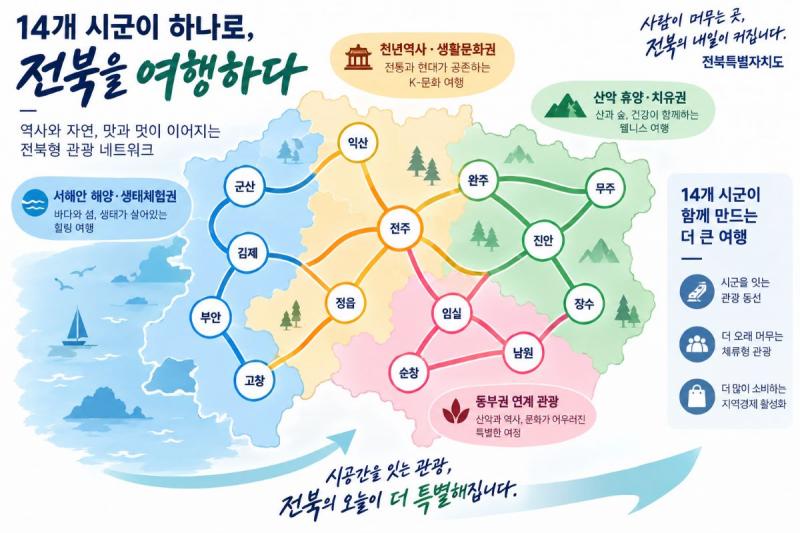
The province plans to redesign its fragmented tourism policies, which were previously pursued by 14 cities and counties, into a focused and selective approach. The new strategy aims to move away from simple quantitative expansion or facility-centered development towards improving the region's unique stories and themes through content-centric enhancements. The key focus is on diversifying visitor routes through interconnection between cities and counties to maximize visitor stays and local spending.
According to data presented at the 11th National Tourism Strategy Conference, the economic effect of 62 tourists' spending is equivalent to that of one resident in a population-decreasing area. In a situation where population influx is not easy, the strategy aims to fill the economic gap through related populations. Moreover, based on the Industrial Input-Output Table of the Bank of Korea, while the manufacturing industry only generates 4.7 jobs per unit of investment, the tourism industry generates more than double, at 10 jobs. This dual strategy aims to create employment and improve residents' living conditions.
However, there are significant challenges to address. Data from the Korea Tourism Organization's Data Lab for the second quarter of 2026 shows that the lodging and consumption performance in North Jeolla Province is relatively low compared to the length of visitor stays. There exists a structural limitation where visitors stay for long periods but do not translate into actual spending. Reasons cited include the lack of infrastructure such as 5-star hotels or large convention/theme parks, the absence of permanent nighttime programs and flagship shopping content, and difficulties in attracting private capital due to inadequate investment incentives compared to the manufacturing sector.
Additionally, the success of Jeonju Hanok Village, which attracts over 10 million visitors annually, has not been fully extended to the entire province. Criticisms have been raised that investments in areas similar to decks and observation decks in other regions have not preserved each region's unique brand value. The absence of an international airport or cruise terminal to directly accommodate foreign tourists has also been a hindrance.
In response, North Jeolla Province has declared a significant shift towards stay-and-consume tourism. Through relaxation of regulations and expansion of investment incentives, the province aims to actively attract private investments. It plans to enhance nighttime content significantly based on the Jeonju Night Tourism Special City and the Buan-Muju Night Tourism Promotion City projects. Additionally, plans include activating food tourism through events like the K-Food Festival and K-Food Road, expanding half-priced travel, and opening visitors' wallets.
To strengthen intercity cooperation, the province will explore tourism rights based on visitor routes and operate a North Jeolla Tourism Consultative Body encompassing provincial and city/county foundations. The 8th North Jeolla Tourism Development Plan will establish a connected system that highlights regional characteristics in areas such as millennium history and cultural life, West Sea coastal marine and ecological experiences, and mountain leisure and healing.
Simultaneously, efforts will be accelerated in global marketing and expanding regional networks. By commercializing local assets like national heritage night tours, K-Tourism Islands, and the West Sea Blue Tourist Belt, the province aims to promote mountain tourism globally through events like the Muju GTWS Grand Final in October and the longest-distance trail connecting Jinan and Muju in the eastern region.
To diversify the influx of foreign tourists, the province plans to develop integrated products linking Iksan and Jeonju through Cheongju International Airport in line with the government's '5 Major Tourism Rights Centered on Local Airports' policy. It also aims to prepare for the opening of cruise terminals by developing multilingual guidance and improving lodging and services without interruption.
Park Dong-woo, Director of the Culture, Sports, and Tourism Department of North Jeolla Province, stated, "The solution to the era of regional decline is ultimately tourism, and cities and counties cannot increase stays and consumption separately." He added, "Through efforts to relax regulations and expand incentives, we will create conditions for private investment and redesign tourism that connects time and space."
📝 Summary:
North Jeolla Province is focusing on tourism as a solution to combat population decline. The province plans to revamp its tourism policies to enhance visitor experiences and increase local spending. Despite challenges such as low lodging and consumption performance, the province aims to attract more private investments and improve nighttime content to boost tourism.
🗣️ Korean Translation:
북전라도는 인구 감소를 극복하기 위해 '관광'을 중요한 해결책으로 내세웠습니다. 도는 관광정책을 개편하여 방문객 경험을 향상시키고 지역 소비를 증가시킬 계획입니다. 숙박 및 소비 성과가 낮은 등 여러 어려움이 있지만, 도는 더 많은 사적 투자를 유치하고 관광을 촉진하기 위해 야간 콘텐츠를 개선할 것입니다.
❓ Comprehension Questions:
1. What is the main solution that North Jeolla Province is focusing on to address population decline?
북전라도가 인구 감소에 대처하기 위해 주력하는 주요 해결책은 무엇인가요?
2. What are some of the challenges mentioned in the article regarding tourism in North Jeolla Province?
기사에서 언급된 북전라도의 관광에 대한 어려움은 어떤 것이 있나요?
3. How does the province plan to attract more private investments for tourism development?
도는 관광 발전을 위해 어떻게 더 많은 사적 투자를 유치할 계획인가요?
💡 Vocabulary Learning:
1. tourism (명사, 관광)
- the activity of traveling to a place for pleasure
- 관광은 즐거움을 위해 어떤 장소로 여행하는 활동입니다.
- Many countries rely on tourism as a major source of income.
- 많은 나라들은 관광을 주요 수입원으로 의존하고 있습니다.
2. enhance (동사, 향상시키다)
- to improve or increase the quality, value, or effectiveness of something
- 향상시키다는 무언가의 품질, 가치 또는 효과성을 향상시키는 것을 의미합니다.
- Adding more features can enhance the user experience of the product.
- 더 많은 기능을 추가하면 제품의 사용자 경험을 향상시킬 수 있습니다.
3. revamp (동사, 개편하다)
- to change, improve, or arrange something again in order to make it more modern or effective
- 무언가를 더 현대적이거나 효과적으로 만들기 위해 다시 변경하거나 개선하는 것을 의미합니다.
- The company decided to revamp its marketing strategy to attract younger customers.
- 회사는 더 많은 고객을 유치하기 위해 마케팅 전략을 개편하기로 결정했습니다.
4. incentive (명사, 인센티브)
- something that encourages you to do something
- 무언가를 하도록 동기를 부여하는 것
- Financial incentives can motivate employees to work harder.
- 금전적 인센티브는 직원들이 더 열심히 일할 수 있도록 동기부여할 수 있습니다.
5. combat (동사, 대항하다)
- to try to stop something unpleasant or harmful from happening or increasing
- 불쾌하거나 해로운 일이 발생하거나 증가하는 것을 막으려고 노력하는 것
- The government is taking steps to combat climate change.
- 정부는 기후 변화를 대항하기 위한 조치를 취하고 있습니다.

💬 댓글 (0)
댓글을 작성하려면 로그인이 필요합니다.
로그인첫 댓글을 작성해보세요!