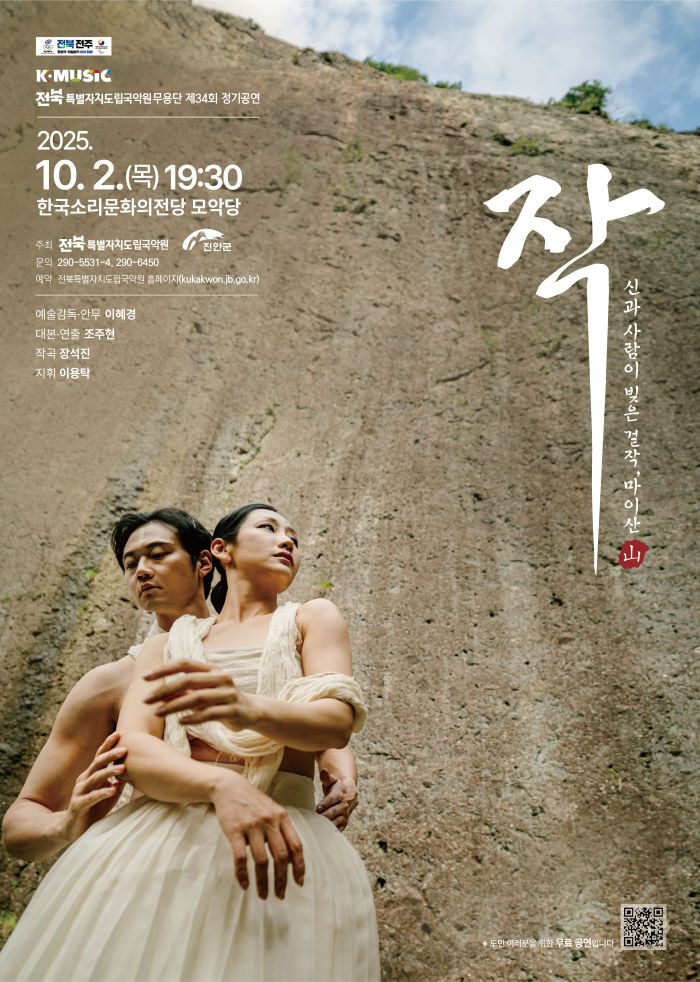
The Jeonbuk Special Self-Governing Province National Gugak Center Dance Company will present the 34th regular performance of the creative dance drama "Jag (作) - Majisan, a Masterpiece Created by God and Humans" at the Hanok Hall of the Korean Sound Culture Center on October 2nd at 7:30 p.m.
The dance company has been planning a series of regular performances titled "<Stories of the People Who Lived on This Land>", which excavates historical and cultural assets unique to Jeonbuk Special Self-Governing Province and transforms them into dance art.
The first part, "Jingyeong," depicted the life of a farmer in the Honam Plain in Gimje, the second part, "Goseomseom," portrayed the life of a fisherman in Wido, Buan, and the third part, "River," dramatized the stories of the Geumgang River and Mangyeong River in Gunsan. This fourth part, "Jag (作)," is a work that artistically reinterprets the myths, legends, and folklore surrounding Majisan in Jinan.
Majisan, the subject of this piece, boasts a mysterious landscape that reveals different forms depending on the direction, formed over millions of years through the accumulation of sediment from the Mesozoic freshwater lake. Majisan, with its cliffs resembling beehives carved by wind and rain, is a symbol representing Jeonbuk Special Self-Governing Province and decorates the finale of the series.
The regular performance "Jag (作)" is composed of a total of eight acts, including an overture and an epilogue, symbolically representing heaven, god, human, and earth.
The performance starts with the overture "Heaven's Creation," followed by Act 1 "Boundary between Heaven and God," which expresses the Cheongsilbaenamu of Eunsusa and the faith of Jecheon, Act 2 "God and Human," a reinterpretation of the founding myth of Yi Seong-gye through Taekwondo, Act 3 "Towards People," unfolding the origin of Doltop and Majisan, Act 4 "Two Peaks," containing the legends of Sumaibong and Ammaibong, Act 5 "Running the Land," expressing the vigorous galloping of the mountain resembling a horse's ear, Act 6 "Majisan," depicting the mountain as a symbol encompassing everything, and finally, the epilogue "Passing the Mountain," conveying a message of coexistence between the mountain and humans.
The music combines traditional instruments with Western instruments to embody both Eastern colors and modern sensibilities simultaneously. Voice and vocal music were used to express oral traditions and the story of Doltop. The Taekwondo scene incorporated intense percussion rhythms and electronic sounds. Additionally, different theme music for each act was utilized to modulate dramatic tension, enhancing the audience's immersion through live performances.
The collaboration with local universities is noteworthy in this performance. The Ssaulabi Taekwondo Demonstration Team from Chonju University portrayed the Taekwondo scene in Act 2 "God and Human" more powerfully and magnificently. Moreover, a dozen members of the Janggu Guest Performance Group, composed of graduates from the Department of Korean Traditional Music at Wooseok University, enhanced the resonance of the scene. Particularly, the janggu is a musical instrument symbolizing 'rain' among the instruments used in shamanic rituals, and in this performance, it realistically reproduces the sound of rain, intensifying the dramatic tension and narrative depth.
The choreography combined Geumchukmu and Taekwondo forms to create dynamic yet restrained movements. By intersecting straight and curved lines, it expressed the flow of the mountain landscape and energy. Korean symbolic props such as 'bak,' an instrument containing the sounds of Geumchuk and horse hooves, were actively utilized to enhance the meaning of the piece.
The production team, including Art Director Lee Hye-kyung, Director Jo Ju-hyun, and Composer Jang Seok-jin, who have been involved in the "<Stories of the People Who Lived on This Land>" series, have strengthened the continuity and stability of the work by participating again. Building on previous collaborative experiences, they are expected to present a more robust and high-quality performance.
In particular, this performance serves as the final regular performance led by Art Director Lee Hye-kyung, marking the culmination of four years of dedication and passion. Art Director Lee Hye-kyung has consistently expanded the artistic horizons of the National Gugak Center Dance Company by preserving traditional roots while continuously attempting new stages. This stage, based on the strong collaboration with the members who have breathed together over the years, will be a special moment that encapsulates the creative and stage experiences accumulated over decades.
Art Director Lee Hye-kyung expressed, "Majisan is a masterpiece created by heaven and humans, polished by wind and time. This stage is my final regular performance with the dance company, and I hope to share the mythological and artistic values cherished by Jeonbuk through the story of Majisan." She added, "I hope this work becomes a new leap and the starting point of hope for the dance company."
? Summary:
The Jeonbuk Special Self-Governing Province National Gugak Center Dance Company is presenting their 34th regular performance, "Jag (作) - Majisan, a Masterpiece Created by God and Humans," at the Hanok Hall of the Korean Sound Culture Center. This performance is part of a series that transforms historical and cultural assets unique to Jeonbuk Special Self-Governing Province into dance art, with this particular piece focusing on the myths, legends, and folklore surrounding Majisan in Jinan.
?️ Korean Translation:
전북특별자치도국립국악원무용단은 한옥관에서 10월 2일 오후 7시 30분에 34회 정기공연인 창작무용극 '작(作) - 하늘과 인간이 창조한 걸작, 마지산'을 선보일 예정입니다. 이번 공연은 진안의 마지산을 중심으로 한 신화, 전설 및 민속을 예술적으로 재해석하는 작품입니다.
❓ Comprehension Questions:
1. What is the focus of the 34th regular performance by the Jeonbuk Dance Company?
한국의 소리문화센터 한옥관에서 34회 정기공연인 '작(作) - 하늘과 인간이 창조한 걸작, 마지산'은 무엇에 중점을 두고 있나요?
2. How many acts are included in the performance "Jag (作)"?
'작(作)' 공연에는 몇 개의 행위가 포함되어 있나요?
3. What is the significance of Majisan in the context of the performance?
공연에서 마지산의 의미는 무엇인가요?
? Vocabulary Learning:
1. excavation, 발굴, noun
- The excavation of ancient artifacts revealed a hidden treasure.
- 고대 유물의 발굴로 숨겨진 보물이 나타났다.
2. folklore, 민속, noun
- The region is rich in folklore and traditional stories passed down through generations.
- 그 지역은 세대를 거치며 전해져 온 민속과 전통 이야기가 풍부하다.
3. orchestrate, 조정하다, verb
- The director orchestrated the scenes to create a seamless flow of the story.
- 감독은 이야기의 순조로운 흐름을 만들기 위해 장면을 조정했다.
4. immersion, 몰입, noun
- The audience felt a deep sense of immersion in the performance.
- 관객들은 공연에 깊게 몰입한 느낌을 받았다.
5. collaboration, 협업, noun
- The successful collaboration between the artists resulted in a stunning masterpiece.
- 예술가들 간의 성공적인 협업으로 멋진 걸작이 탄생했다.

💬 댓글 (0)
댓글을 작성하려면 로그인이 필요합니다.
로그인첫 댓글을 작성해보세요!