"The reason why the regulations do not change on the field, was explained in today's language of the system."
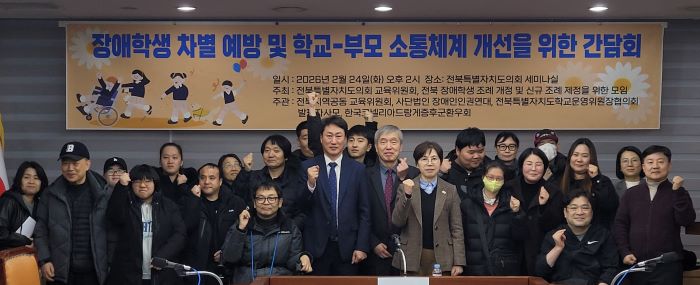
The Education Committee of the Jeonbuk Special Self-Governing Province Council held a meeting on the prevention of discrimination against students with disabilities and the improvement of communication between schools and parents on the 24th at 2 p.m. in the seminar room of the council.
This meeting was organized to diagnose the repeated discrimination against students with disabilities and the gaps in the implementation of regulations at school sites, and to discuss directions for system improvement. It was requested by a meeting composed of the Jeonbuk Special Self-Governing Province School Operations Committee, the Jeonbuk Regional Joint Education Committee, the Disability Rights Alliance, Balpyeongja Community, and the Korean Cornelia de Lange Syndrome Association through an official document to the council.
The meeting was attended by Jin Hyeong-seok, the head of the Jeonbuk Council Education Committee, National Assembly member Gu Guk-jung, Namwon Elementary School Principal Ahn Jung-man, disability organization representatives, and representatives of parents of students with disabilities. The meeting was conducted socially by Kim Hak-san, the head of the Jeonbuk Regional Joint Committee.
Jomyeong-sil, the head of the Jeonbuk Special Self-Governing Province School Operations Committee, presented the topic of proposing the establishment of regulations for supporting the school life of type 1 diabetes students.
Jomyeong-sil emphasized the urgent need for institutional preparation as type 1 diabetes students will be officially recognized as students with disabilities starting from July 2026. Type 1 diabetes is an autoimmune disease that does not produce insulin on its own, and due to various factors such as hormonal changes, stress, exercise, sleep, blood sugar levels can fluctuate unpredictably, leading to emergencies of hypoglycemia or hyperglycemia at any time, including during school hours.
However, in reality, despite the necessity of continuous glucose monitoring devices (CGM) and Bluetooth connectivity with mobile phones for blood sugar management, parents are unable to share real-time blood sugar levels due to restrictions on bringing electronic devices to school, leading to anxious situations even before attending school. It was also pointed out that there is no immediate response system in the absence of a school nurse, insulin administration errors, incorrect instructions during field trips, and cases where the entire swimming class is replaced with home study, which structurally infringes on the rights to life, education, and participation of students.
Jomyeong-sil stated, "Discrimination prevention education is limited to formal online video lectures, and during exams, consuming snacks for hypoglycemia or using mobile phones is distorted as 'special treatment,' leading to a decline in children's self-esteem." He appealed that the structure where all these burdens are concentrated only on the guardians should change.
Therefore, he proposed the establishment of the "Regulations for Supporting the School Life of Type 1 Diabetes Students," requesting that the regulations specify provisions such as mandatory establishment of emergency response manuals, permission for bringing electronic devices, guarantee of consuming snacks for hypoglycemia during exams, establishment of initial counseling systems upon admission, regular education for school staff and peer students, establishment of a system for cooperation with the local community and medical institutions, and financial support clauses.
Kim Eun-joo, the representative of the Korean Cornelia de Lange Syndrome Association who participated in the discussion, exclaimed, "Our child is 14 years old, at the age of the first year of middle school, but after 13 years of deferral, he is finally entering the first grade of elementary school. We have been waiting to see if the school will accept a severely disabled child who cannot communicate or walk. When we contacted the school, the teachers had no idea about the condition, and parents had to create an 'explanatory note' to persuade them. We don't even know how long our child can attend. Rare and severe children with a wide range of disabilities also have the right to education. Instead of leaving it to the efforts of parents, the school and regulations should be prepared first."
Yoon Mi-yeon, the chairperson of the Jeonbuk Special Self-Governing Province School Operations Committee, emphasized, "In schools within Jeonbuk, cases of discrimination against students with disabilities such as avoidance of homeroom teachers, passing on responsibilities through sick leave, de facto coercion of transferring schools, and non-compliance with convenience support are repeated." She stressed that the current "Jeonbuk Special Self-Governing Province Regulations on Support for Students with Disabilities" and "Jeonbuk Special Self-Governing Province Special Education Promotion and Support Regulations" lack provisions for checking compliance to prevent such discrimination, regulations on managerial responsibilities, and sanctions in case of violations, which are the core issues.
Imi Ra, the representative of Balpyeongja Community, pointed out, "More than half of the students targeted for special education in Jeonbuk have developmental disabilities (intellectual disabilities 51.3%, developmental delays 19.0%, autism spectrum disorders 13.2%), but due to structural limitations in expressing opinions, there is a blind spot in human rights where damages occur without being spoken of and discovered. The 'safety-protection' pretext leads to physical restraint and infringement of self-determination rights, formalization of individualized education plans (IEPs), non-compliance with standards for setting up special classes, and structural problems of exclusion in integrated classes."
She further suggested, "Referring to the UN CRPD and exemplary cases from the US and Germany, new provisions should be added to the regulations for ▲support for communication, ▲checking compliance with IEPs, ▲prohibition of forced control under the pretext of 'safety' and mandatory establishment of alternative support systems, and ▲mandatory education for teachers' professionalism, to reflect these aspects of human rights and budget in the regulations."
Gu Guk-jung, a member of the Jeonbuk Council, stated, "The reality of inclusive education is serious. Many non-disabled students and parents often show reluctance to be with students with developmental disabilities. Currently, they are only physically mixed, and it is essential to deploy learning support personnel and expand auxiliary staff." He added, "As with the new regulations for supporting type 1 diabetes students, the readiness of the regulatory body for operation is crucial. Infrastructure development, independent self-management spaces, support for diet and exercise management, emergency treatment training for school staff, and education on disabilities for students are necessary practical measures."
He also emphasized, "Support for students with disabilities is impossible without a budget, personnel, and monitoring system, and regulations should be accompanied by these human rights aspects and budget considerations."
Choi Chang-hyun, the representative of the Disability Rights Alliance, said, "Support for students with disabilities incurs significant costs in physical activities such as sports, and support for the education and learning rights of students with disabilities should be approached from two dimensions (infrastructure + personnel). Cases of refusal to register disabilities due to the stigma effect are also occurring. Regulations must be backed by budget, personnel deployment, and monitoring systems to be effective."
Ahn Jung-man, the principal of Namwon Elementary School, expressed, "I felt sorry and ashamed while listening to the stories of parents today. I keenly feel the 13-year wait of parents with disabled children and the high threshold of schools. Currently, schools are becoming judicialized and litigious rather than educational institutions, causing teachers to become demoralized. However, there are still many people in the field who are trying hard."
He continued, "Beyond overcoming each other's pain and wounds, we need to work together with those who are making efforts within the school to find specific solutions. We need to complement the shortcomings to ensure that the regulations are well applied on the field and become individuals who carefully observe each child."
Jin Hyeong-seok, the head of the Jeonbuk Council Education Committee, concluded, "Simply changing the wording of the regulations and pushing in the budget will not solve the problem. If the seriousness of rare diseases and the perception of students with disabilities are not properly understood, it will be of no use. Even if the rights of students with disabilities are recognized, it is impossible without actual budget and personnel." He summarized, "Regulations should not be abstract declarations but should include concrete plans for financial and personnel deployment to ensure the implementation on the field." He also said, "I will study more and, even if it takes time, I will push forward the regulations in a concrete manner."
Kim Hak-san, the head of the Jeonbuk Regional Joint Committee, in his closing remarks at the meeting, said, "Listening to the heartbreaking stories of parents, I keenly felt the pain of disabled children that cannot be understood by documents and explanations alone. We cannot make all teachers experts, but we need to narrow the gap through systematic system establishment." He concluded, "As Principal Ahn Jung-man mentioned, there are many cases in the field. Regulations should not just be a simple change in wording but should be a system that understands the pain of parents and leads to practical support."

💬 댓글 (0)
댓글을 작성하려면 로그인이 필요합니다.
로그인첫 댓글을 작성해보세요!