<b>Assignment of Homeroom Teachers Completed on February 23rd → Notice Sent on February 24th "In Case of Vacancy"
Labeling Unconfirmed Legal Matters as 'Malicious Complaints', Ignoring Transfer and Unpaid Leave Appeals of Affected Students</b>
Ahead of the upcoming Jeonbuk Superintendent of Education election, the Jeonbuk branch of the National Teachers Union (hereinafter referred to as the Jeonbuk branch of the NTU) has raised concerns that the 'Education Activity Protection Policy Consent Form' sent to the superintendent candidates distorts facts, violates election laws, and involves complex legal issues such as spreading false information. In particular, teachers affiliated with the NTU are concerned that despite election campaigning being prohibited under the Public Official Election Act, this consent form could effectively function as a tool for specific electoral influence.
<b>Decisive Contradiction — The Date of the Notice Says It All</b>
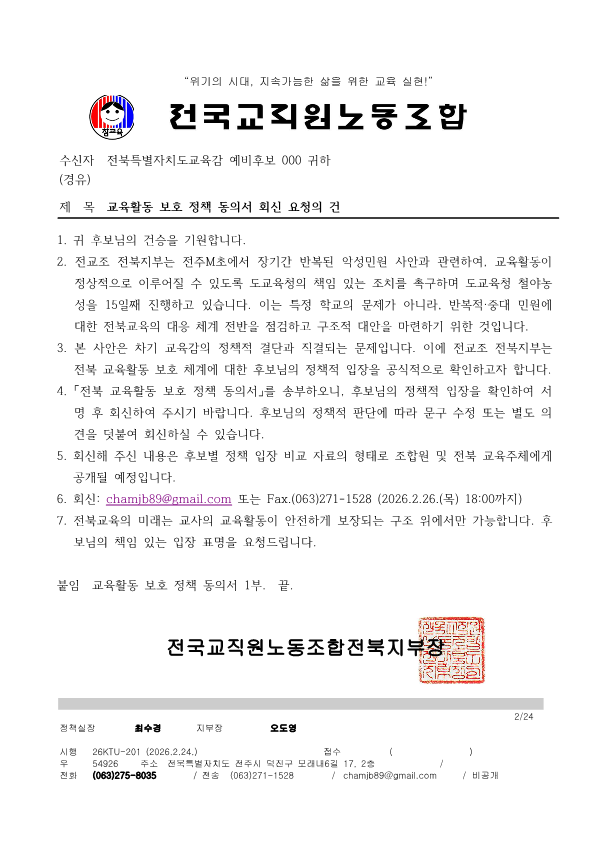
In the notice (26KTU-201, February 24, 2026) publicly released by the Jeonbuk branch of the NTU, the first item requests candidates to protect teachers and students from malicious complaints through possible administrative measures such as assigning a scholarship advisor or counselor in case of a vacancy in the homeroom teacher position at Jeonju M Elementary School. However, on February 23, 2026, a day before this notice was sent, a new homeroom teacher had already been assigned at Jeonju M Elementary School. Furthermore, it is a fact that the head of the Jeonbuk branch of the NTU posted in a group chat that they had met with the assigned homeroom teacher but later deleted the message.
The Jeonbuk branch of the NTU sent the policy consent form the day after a homeroom teacher had been assigned. If this was a mere mistake, it implies that the organization, which had portrayed itself as directly involved in the Jeonju M Elementary School case, sent the notice to the election candidates without even verifying the homeroom assignment status of that school. However, if they were aware of the homeroom assignment but still sent the notice, it can only be seen as an intentional attempt to create a non-existent crisis to solicit specific political endorsements from the candidates.
The context of the situation is even more serious. In 2025, a teacher, a former head of the Jeonbuk branch of the NTU, publicly announced on social media their intention to apply for a transfer to Jeonju M Elementary School right after reporting parents. Subsequently, they were indeed assigned as the homeroom teacher for that class. On February 10, 2026, the Jeonbuk branch of the NTU held a press conference stating that they would continue their 15-day sit-in protest, questioning who would take charge of that class. Thirteen days later, on February 23, a homeroom teacher was assigned, and the next day, the NTU still sent a notice assuming a vacancy, with the prospective candidates eventually publicly disclosing their responses.
<b>Labeling Unconfirmed Legal Matters as 'Malicious Complaints' — Potential for Defamation</b>
The Jeonbuk branch of the NTU explicitly mentions in the notice the "long-standing repeated malicious complaints" at Jeonju M Elementary School and inserts the term 'malicious complaints' directly into the question section. This is a typical leading question structure designed to automatically make the candidates accept the frame that parents are 'malicious complainers,' whether they agree or disagree.
However, the legal status of this matter is entirely different from the claims of the NTU. Despite multiple complaints filed against parents by the NTU and subsequent police investigations resulting in dismissals, conflicting reports have persisted in local media, and the legal disputes are ongoing. Labeling a specific individual as a 'malicious complainer' in an issue not legally confirmed and using it as election public material poses a risk of defamation through the dissemination of false information in publications and press releases. Last year, the Jeonbuk branch of the NTU spread blatantly false information to the media regarding a school visit by a journalist.
<b>Erasing the Truth with Consent Forms — Unpaid Students, Transferred Students</b>
There is a reality not addressed in the NTU's policy consent form. One of the students affected by the Red Card incident ultimately chose to transfer schools to avoid the homeroom teacher. Another student's experience is even more harrowing.
After the former head of the Jeonbuk branch of the NTU reported parents and publicly announced their assignment as the homeroom teacher at the school, the police issued a restraining order against that homeroom teacher. Following the restraining order, the student could only enter the classroom during the homeroom teacher's teaching hours and had to attend separate classes. There were reports that a parent, upon hearing that their child decided to attend C teacher's classes, expressed emotions they could not contain, saying, "The child made that decision to protect the mother."
However, the students faced repeated distressing situations and appealed severe psychological suffering. One student transferred schools, while the other eventually needed hospital treatment. In a situation where normal school life was impossible, leading to the inability to fulfill attendance requirements, the latter student was ultimately put on unpaid leave.
In an environment where a teacher who reported their own parents and had a restraining order issued by the police still showed up at the same school daily, what kind of suffering did the child have to endure? The fact that the police had to intervene to prevent the teacher from approaching the student demonstrates how inappropriate the initial homeroom assignment was from a student protection perspective. However, none of these circumstances were mentioned in the NTU's policy consent form.
<b>Reasons for Divergent Responses from Candidates</b>
Candidates Cheon Hosung, Hwang Hojin, and Yoo Sungdong expressed full agreement with all three items presented by the NTU. At the moment they signed, they officially accepted a one-sided narrative that contradicted the fact of a homeroom vacancy, a provision labeling 'malicious complaints' without legal confirmation, and a narrative ignoring the reality of affected students. On the other hand, candidate Lee Namho added an additional opinion to the first item, stating, "After confirming the accurate facts, I will express my intention to ensure teacher educational activities to the maximum extent possible." This judgment, demanding fact verification first, ultimately proved to be the most accurate decision as it revealed the discrepancy between the core premise of the notice and the facts.
<b>Real Conditions for Restoring the Educational Community</b>
The restoration of the educational community cannot be achieved through a one-sided narrative alone. The principle that teachers should be guaranteed normal teaching activities is correct. However, this principle cannot be established while ignoring the voices of students appealing for help. Repeat complaints arise even when problems remain unresolved. When educational administration fails to resolve conflicts through active dialogue and communication, the resulting harm falls entirely on the students. The child who ended up on unpaid leave after enduring hospital treatment is a clear example of this.
It is valid for teacher organizations to objectively compare candidates' positions on educational policy issues. However, demanding signatures based on false premises, labeling unconfirmed legal matters, and questioning the candidates with untrue content as teachers prohibited from election campaigning is not related to restoring the educational community. In the Superintendent of Education election that will determine the future of education in Jeonbuk, voters must confront the truth revealed by this single notice.
? Summary:
The Jeonbuk branch of the National Teachers Union has raised concerns about a consent form sent to superintendent candidates distorting facts and involving complex legal issues. The notice sent by the union raised questions about assigning a homeroom teacher despite one already being in place, leading to suspicions of intentional manipulation for political influence.
?️ Korean Translation:
전북교육감 선거를 앞두고 교육부문 노동조합 전북지부는 교육활동보호정책 동의서가 사실을 왜곡하고 선거법을 위반하며 거짓 정보를 전파하는 복잡한 법적 문제에 관련되어 우려를 제기했습니다. 조사결과, 이미 홈룸 선생님의 배정이 이루어진 상황에서 전북교육감 지부가 후보들에게 전송한 공지는 정치적 영향력을 행사하기 위한 의도적인 조작을 시도했을 가능성이 있음을 시사합니다.
❓ Comprehension Questions:
1. What concerns did the Jeonbuk branch of the National Teachers Union raise about the consent form sent to superintendent candidates?
교육부문 노동조합 전북지부가 교육감 후보에게 보낸 동의서에 대해 어떤 우려를 제기했습니까?
2. Why was there suspicion of intentional manipulation for political influence regarding the assignment of a homeroom teacher?
홈룸 선생님의 배정과 관련하여 정치적 영향력을 위한 의도적인 조작에 대한 의심이 있었던 이유는 무엇인가요?
3. How did candidate Lee Namho's response differ from the other candidates regarding the notice sent by the NTU?
이름이 후보자들 중 리 남호 후보의 반응이 교육부문 노동조합이 보낸 공지와 다른 점은 무엇이었나요?
? Vocabulary Learning:
1. distort (왜곡하다) - verb
- To distort facts means to twist or misrepresent information.
- 사실을 왜곡한다는 것은 정보를 비틀거나 잘못 표현하는 것을 의미합니다.
- Example sentence: The media should not distort the truth to create sensational stories.
- 예문: 언론은 선정적인 이야기를 만들기 위해 진실을 왜곡해서는 안 됩니다.
2. intentional (의도적인) - adjective
- If something is intentional, it is done on purpose.
- 의도적인 것은 의도적으로 한 것을 의미합니다.
- Example sentence: The intentional act of vandalism led to serious consequences.
- 예문: 의도적인 악의 행위로 심각한 결과가 초래되었습니다.
3. defamation (명예 훼손) - noun
- Defamation refers to damaging someone's reputation through false statements.
- 명예 훼손은 거짓된 주장을 통해 누군가의 평판을 손상시키는 것을 의미합니다.
- Example sentence: The celebrity filed a lawsuit for defamation against the tabloid that published false stories about them.
- 예문: 유명인이 자신에 대한 거짓 이야기를 게재한 타블로이드에 대해 명예훼손 소송을 제기했습니다.
4. premises (전제) - noun
- Premises are the foundational ideas or assumptions on which something is based.
- 전제란 무엇인가가 기반을 둔 기본 아이디어나 가정을 의미합니다.
- Example sentence: The argument fell apart due to faulty premises that were not supported by evidence.
- 예문: 증거로 뒷받침되지 않은 잘못된 전제로 인해 논쟁이 붕괴되었습니다.
5. narrative (이야기) - noun
- A narrative is a story or account of events.
- 이야기란 사건의 설명이나 이야기입니다.
- Example sentence: The novel presented a compelling narrative that captivated readers until the last page.
- 예문: 소설은 마지막 페이지까지 독자들을 사로잡는 흥미진진한 이야기를 제시했습니다.

💬 댓글 (0)
댓글을 작성하려면 로그인이 필요합니다.
로그인첫 댓글을 작성해보세요!