Starting from the first grade in 2025, the high school credit system has been implemented, leading to unverified news being reported as facts through the media. One claim was that the number of students with top grades in all subjects had increased significantly, causing a sharp decline in the discriminative power of the grades. Another claim suggested that due to the student-centered elective education system, frequent class changes had led to excessive student fatigue and completely destroyed peer relationships during school years.
School curriculums are organized differently in each school depending on the regional atmosphere for college entrance. Therefore, it was difficult to verify the accuracy of media reports based solely on specific regions or schools.
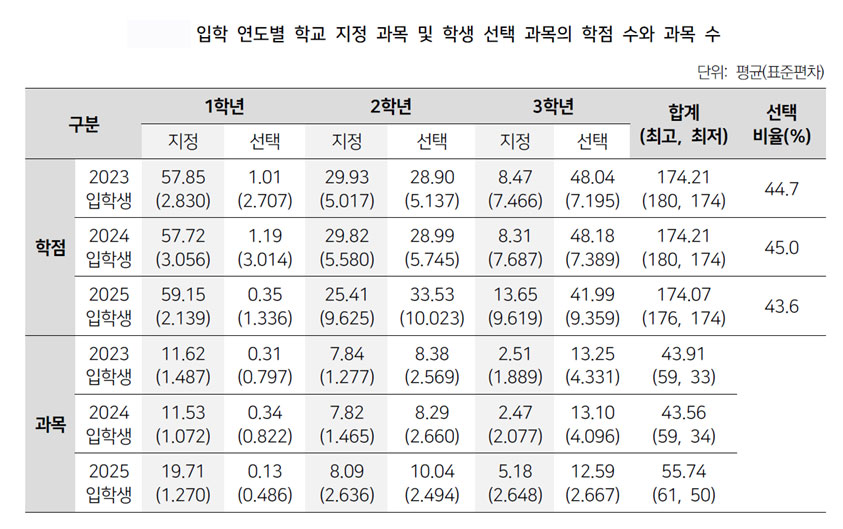
The Korea Institute of Curriculum and Evaluation released a report titled "Trends in School Curriculum Organization in the First Year of Full Implementation of the High School Credit System." The report provided valuable data extracted from the 3-year school curriculum organization tables of 2025 incoming students from a total of 68 schools, with 4 schools from each of the 17 cities and provinces, publicly available on the School Information System (schoolinfo.go.kr). Based on the "Credit Points and Number of Subjects Designated and Selected by Schools and Students by Admission Year," the report aimed to compare and analyze the operational status of education curriculums in the entire country and Jeonbuk Province, while also verifying the content of media reports.
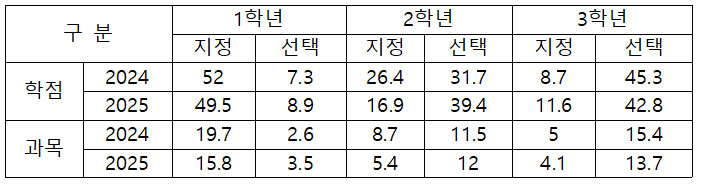
In the 2015 and 2022 curriculums, the first grade follows a national common curriculum. Therefore, most subjects are designated for operation. The percentage of elective subjects in the first grade is less than 1%, indicating minimal class changes. Thus, all reports related to class changes in the first grade are false. The following chart analyzes the data from 23 general high schools in Jeonju based on the report content.
The first-grade curriculum organization is similar nationwide, but Jeonju region has relatively more elective credits and subjects. Courses such as Technology/Home Economics/Information, and Second Foreign Language/Chinese are mostly designated as elective subjects. In other regions, these subjects are either included in the 2nd or 3rd grade curriculum or operated as designated subjects.
The selection of elective subjects starts from the second grade. There are slight differences between 2023, 2024, and 2025. The number of designated subjects (credits) increased from 7.8 (29) to 8.1 (25), but the credits slightly decreased. The number of elective subjects (credits) increased from 8.3 (28.9) to 10 (33.5). The average number of designated subjects per semester remains around 4, while elective subjects increased from 4 to 5. The credits per subject decreased from 3.72 to 3.1 for designated subjects and from 3.5 to 3.3 for elective subjects.
As a result, the number of subjects per semester increased from 8 to 10. This seems to be a result of the SAT exploration area and the recommended subjects by universities. With a decrease in credits per subject, students' academic burden has increased, and teachers are facing difficulties in teaching multiple subjects and student management. It is disappointing to see that the original intention of curriculum organization and operation to provide sufficient flexibility to teachers and students through a 4-credit semester system has been significantly compromised by external factors such as the college entrance examination.
In the Jeonju region, the number of designated subjects (credits) decreased from 8.7 (26.4) in 2024 to 5.4 (16.9) in 2025, while the number of elective subjects (credits) increased from 11.5 (31.7) to 12 (39.4). The national trend shows a stable number of designated subjects (credits), but Jeonju region experienced a significant decrease. This is likely due to some schools including Korean, English, and Math as elective subjects rather than designated ones. The credits for elective subjects increased from 2.75 to 3.28, similar to the national average.
The confusion caused by class changes, which was heavily criticized in the media, is estimated to be around 50% for the second grade. This is because many schools organize classes based on elective subjects by field, even though they are not designated. The claim that the student-centered curriculum is leading to the disappearance of class concepts and the destruction of peer relationships seems exaggerated.
According to the evaluation report and the curriculum organization in the Jeonju region, the claim that all subjects' top students are increasing, leading to a significant decrease in the discriminative power of grades, is hard to believe. In the case of the second grade, where the number of elective subjects per semester is 5, unlike the first grade with less than 2 elective subjects, the pool of students is smaller, which may increase the discriminative power. The discriminative power in the third grade is expected to be even higher. Contrary to expectations, the number of designated subjects (credits) increased from 2.5 (8) to 5 (13) under the high school credit system, while the credits for elective subjects decreased from 13.2 (48) to 12.6 (42). In the Jeonju region, the number of designated subjects (credits) decreased from 5 (8.7) to 4.1 (11.6), and the number of elective subjects (credits) decreased from 15.4 (45.3) to 13.7 (42.8).
The relative evaluation maintained until the selection of career elective subjects in the third grade seems to have an impact. The first semester of the third grade shows a designated to elective ratio of 2:6. Unlike in 2015, the first semester of the third grade will have an absolute impact on college entrance. Due to relative evaluation, the third grade first semester is expected to be a triangle of fear between the SAT, internal grades, and special subjects. In conclusion, the claim that the top grade in all subjects is significantly increasing is entirely false. The second and third grades will operate with minimal class changes compared to 2015. It is hoped that through the analysis in the report, speculative reporting and columns close to falsehood can be overcome. However, it is urgent to devise measures to overcome the confusion at school sites caused by the expansion of relative evaluation, the scope of the SAT, and the excessive recommendation of subjects by universities. It is hoped that continuous objective and scientific research activities will be conducted to ensure stable operation of the curriculum and the establishment of the credit system.
? Brief Summary:
The implementation of the high school credit system in 2025 has led to unverified news being reported as facts through the media, such as increased top grades and excessive student fatigue. The Korea Institute of Curriculum and Evaluation released a report to analyze the school curriculum organization and verify media reports. Differences in curriculum organization were found between regions, impacting the number of designated and elective subjects.
?️ Natural Korean Translation:
2025년부터 고등학교 학점제 시행으로 인해, 매체를 통해 사실로 보고되지 않는 뉴스가 발생하고, 최상위 학점이 증가하고 학생 피로가 심하다는 주장 등이 있었습니다. 교육과정평가원은 학교 교육과정 조직을 분석하고 매체 보도를 검증하기 위한 보고서를 발표했습니다. 지역별로 교육과정 조직에 차이가 있어 지정과 선택 교과목 수에 영향을 미쳤습니다.
❓ Comprehension Questions:
1. What are some claims made about the impact of the high school credit system on students?
학점제 시행이 학생들에게 미치는 영향에 대해 어떤 주장들이 있었습니까?
2. How did the Korea Institute of Curriculum and Evaluation aim to verify media reports?
교육과정평가원은 어떻게 매체 보도를 검증하려고 했습니까?
3. What differences were found in curriculum organization between regions?
지역 간 교육과정 조직에서 어떤 차이가 발견되었습니까?
? Vocabulary Learning:
1. implemented / 시행되다 (Verb)
- put (a decision, plan, agreement, etc.) into effect
- 결정, 계획, 협정 등을 실행하다
- The new policy will be implemented next month.
- 새로운 정책이 다음 달에 시행될 것이다.
2. discriminative / 식별력 있는 (Adjective)
- showing or indicating careful judgment and discernment
- 신중한 판단과 분별을 보여주는
- His discriminative taste in music impressed everyone.
- 그의 음악에 대한 식별력 있는 취향은 모두를 감동시켰다.
3. fatigue / 피로 (Noun)
- extreme tiredness resulting from mental or physical exertion or illness
- 정신적 또는 신체적 노력 또는 질병으로 인한 극심한 피로
- She could barely keep her eyes open due to fatigue.
- 그녀는 피로로 눈을 거의 뜨지 못했다.
4. operation / 운영 (Noun)
- the fact or condition of functioning or being active
- 작동하거나 활동하거나 있는 상태의 사실 또는 조건
- The smooth operation of the new machine impressed the workers.
- 새 기계의 원활한 운영은 근로자들을 감동시켰다.
5. compromise / 타협하다 (Verb)
- settle a dispute by mutual concession
- 상호 양보로 분쟁을 해결하다
- They had to compromise on the final decision to move forward.
- 그들은 앞으로 나아가기 위해 최종 결정에 타협해야 했다.

💬 댓글 (0)
댓글을 작성하려면 로그인이 필요합니다.
로그인첫 댓글을 작성해보세요!