<b>"We followed the regulations," claims the board of directors, but failed to comply with the regulations
No recommendation from the principal, rejection by the faculty personnel committee, yet the transfer was enforced - The interpretation of the Legislation Bureau and the Supreme Court rulings directly refute the board's claims</b>
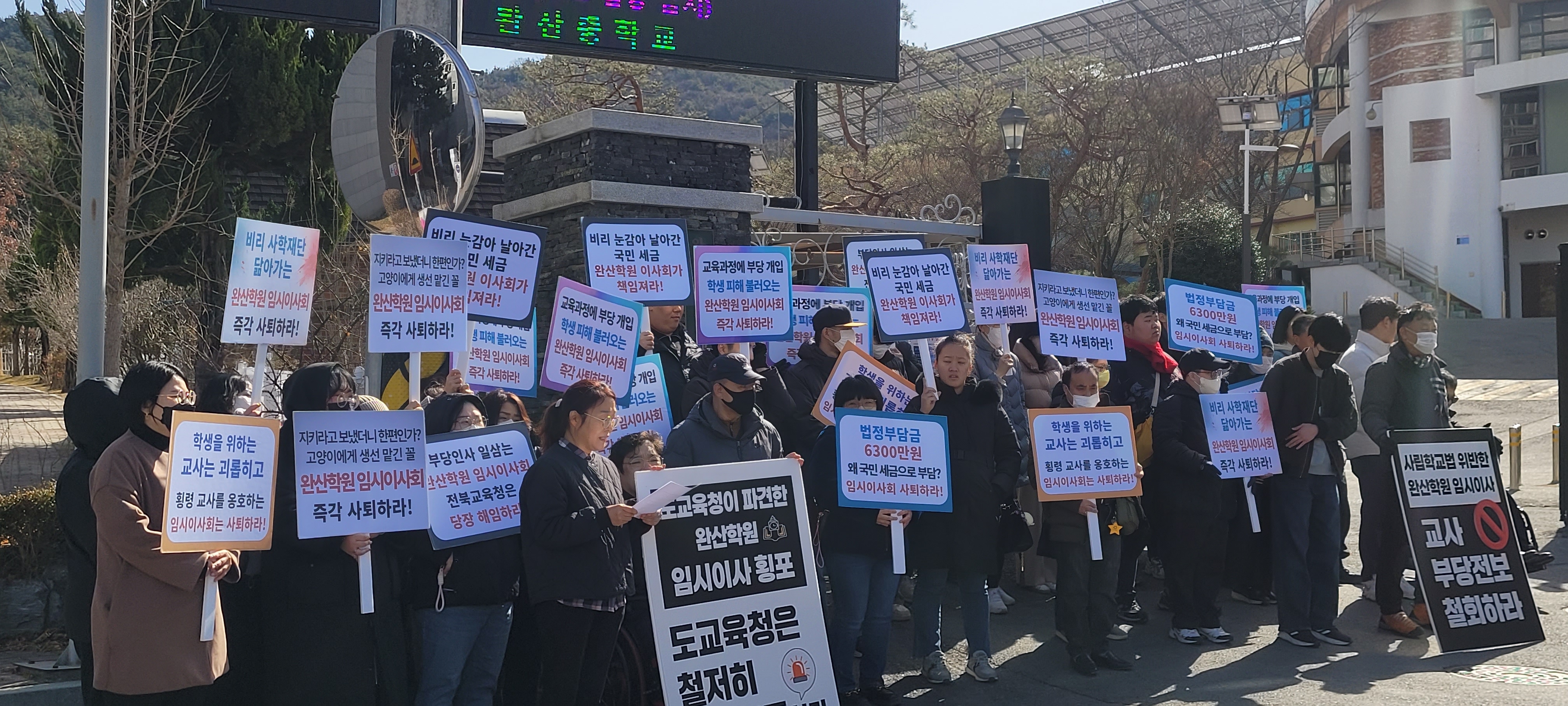
The interim board of directors of Wansan Academy (Chairman Jung Woo-sik) claims that they "exercised their personnel authority legally," but it has been confirmed that they did not adhere to the two key procedures required by the law. The official legal interpretation of the Legislation Bureau and even the Supreme Court rulings directly contradict the board's claims.
<b>The principal did not say "you may send them"</b>
In a private school, in order to transfer a teacher to another school, it is mandatory for the principal of that school to first recommend, i.e., officially request, "you may transfer this teacher." This is a mandatory requirement set forth in Article 53-2, Paragraph 1 of the Private School Act.
In this transfer case, the principal of Wansan Middle School did not make such a recommendation. Nowhere in the board's statement is there any mention that the principal made a recommendation. The first condition required by the law was missing from the beginning.
<b>The deliberative body said "no," but the board enforced it</b>
Private schools have a faculty personnel committee that deliberates on teacher personnel matters. This committee serves as a check and balance mechanism to prevent the board from unilaterally making personnel decisions. Article 53-4 of the Private School Act obligates this.
The faculty personnel committee of Wansan Middle School deliberated on the transfer of Teacher A and concluded with a 'rejection.' However, the board disregarded this result and enforced the transfer regardless. The board claims that they are not bound by the faculty personnel committee, but the official interpretation of the education authorities differs.
"To overturn the deliberation result, there must be a rational reason. Personnel decisions that ignore deliberations are invalid."
The board has not once disclosed their rational reasons for their actions.
<b>The Legislation Bureau already nailed it in 2008 - "Transfers are appointments"</b>
The board has no basis to argue that "transfers are not appointments, so different regulations apply." In July 2008, the Legislation Bureau officially interpreted that under the Private School Act, 'appointments' include not only new hires but also transfers, promotions, demotions, dispatches, leaves of absence, transfers to non-teaching positions, and dismissals. As the basis for this interpretation, the Legislation Bureau cited Supreme Court rulings 79da2168, 2005da62891, and 2003da20725.
The conclusion is clear. Transfers must go through the recommendation of the principal and the deliberation of the faculty personnel committee. This is an established legal principle with no room for interpretation.
<b>The Supreme Court also consistently said "adhere to the procedures"</b>
Following the Legislation Bureau's interpretation, Supreme Court rulings have consistently demanded strict compliance with procedures in private school teacher personnel matters.
A 2012 Supreme Court ruling stated that the appointing authority must strictly adhere to the obligation of prior notification and deliberation procedures in reappointing private school teachers. Even if the board has the authority to make personnel decisions, if the manner in which it exercises that authority ignores the procedures, it is considered unlawful.
A 2022 Supreme Court ruling stated that if the board refuses to appoint a teacher without following the procedures and providing reasons, it constitutes an unlawful decision under the Teacher Status Act. Furthermore, a 2025 Supreme Court ruling reaffirmed the legal principle that the appointing authority must conduct a thorough investigation to determine if a teacher's actions correspond to disciplinary grounds.
Especially in the latest ruling issued in September 2025, the issue of whether the school corporation and the chairman violated legal obligations by not demanding disciplinary action against the affiliated teachers, despite alleging misconduct and opting for transfers instead, has emerged as a new concern. This segment indicates that the board's decision to choose transfers over disciplinary actions, despite alleging misconduct, could lead to future legal liability issues.
<b>If there was misconduct, why was it a transfer instead of disciplinary action</b>
The board alleges that Teacher A had issues such as misuse of business trips, monopolizing positions, and favoritism in class schedules. If these are true, the procedure stipulated by the law is disciplinary action. In disciplinary procedures, evidence must be presented, the parties must be given a chance to explain, and the results must be officially recorded.
However, the board did not follow disciplinary procedures. Instead, they opted for transfers. Transfers do not require such procedures. As a result, Teacher A was left with the impression of being a "problematic teacher" without any opportunity to explain. In line with the essence of the 2025 Supreme Court ruling, the board's decision to bypass thorough investigations and disciplinary procedures could potentially lead to even greater legal issues.
<b>The real content behind the 226 business trip list</b>
The board claims that Teacher A's 226 business trips disrupted academic operations. However, a direct examination of the original business trip list reveals entirely different contents.
The list is filled with activities such as reviewing teacher personnel documents requested by the Jeonju Education Support Office, activities designated by the Jeonbuk Education Office as AI and EduTech leading teacher activities, camps, competitions, and experiential learning guidance with students on weekends and holidays, and teaching activities requested by the education office in various regions of Jeonbuk. More than half of the business trips took place after school hours, on weekends, and during holidays. It is a record of actively engaging in educational activities for Jeonbuk education, not skipping classes.
<b>Offering help, then turning to SNS attacks after rejection</b>
The difficulties faced by Teacher A are not just limited to legal disputes with the board. Recently, a retired teacher from a private school in Jeonju contacted one of Teacher A's colleagues proposing to support a specific candidate for superintendent in connection with this incident. Teacher A declined, stating that they did not want their case to be used in the election.
Subsequently, the retired teacher began publicly attacking Teacher A on social media, revealing their identity and posting defamatory content. The approach masked as goodwill turned into public attacks after rejection. This pattern of goodwill turning into retaliation post-rejection is evident.
Ultimately, Teacher A is facing pressure from three directions simultaneously: the board's organized public relations and legal battles, political pressures from the surrounding authorities, and the SNS attacks labeling them as a "problematic teacher." This is the reality faced by a teacher who dedicated weekends and holidays to on-site activities for Jeonbuk education.
<b>The court's judgment is not yet final</b>
The lower court dismissed Teacher A's provisional injunction application. However, this does not mean that the transfer was deemed legal. A provisional injunction is a temporary judgment made within limited information and time constraints. Teacher A's side is currently appealing, and there are appellate and substantive lawsuits pending.
The core issue of this case is simple. Is it legally permissible for the board to unilaterally enforce a transfer without a recommendation from the principal and a rejection by the faculty personnel committee? The Legislation Bureau has firmly established that transfers are appointments, and the Supreme Court has repeatedly emphasized that personnel decisions ignoring procedures are unlawful. Until the final answer is reached, the board's claim of "legal personnel decisions" should be treated as an assertion requiring verification rather than confirmed fact.
📝 Brief Summary:
The board of directors at Wansan Academy claims they followed regulations when transferring a teacher, but failed to comply with legal procedures. The principal did not recommend the transfer, the faculty personnel committee rejected it, yet the board enforced it. The Legislation Bureau and Supreme Court rulings directly contradict the board's claims.
🗣️ Natural Korean Translation:
완산학원의 임시 이사회(정우식 회장)는 교사 이동을 할 때 법규를 준수했다고 주장하지만, 실제로는 법에 정해진 두 가지 중요 절차를 따르지 않았다는 것이 확인되었습니다. 입법처의 공식적인 해석과 심지어 대법원 판례도 이 이사회의 주장을 직접 반박합니다.
❓Comprehension Questions:
1. What were the two key procedures required by law that the board of directors failed to adhere to?
법에 정해진 두 가지 중요 절차는 무엇이었습니까?
2. Why did the principal not recommend the transfer of the teacher?
교장이 교사 이동을 추천하지 않은 이유는 무엇이었습니까?
3. What did the faculty personnel committee conclude about the transfer, and how did the board respond?
교직원 위원회는 교사 이동에 대해 어떤 결론을 내리고, 이에 이사회는 어떻게 대응했습니까?
💡 Vocabulary Learning:
1. personnel (인사, noun)
- The word "personnel" refers to the employees of an organization or business.
- "인사"는 조직이나 기업의 직원들을 가리키는 단어입니다.
- The personnel department is responsible for hiring new employees.
- 인사부는 새로운 직원을 채용하는 책임이 있습니다.
2. recommendation (추천, noun)
- A "recommendation" is a suggestion or proposal about what someone should do.
- "추천"은 누군가가 무엇을 해야 하는지에 대한 제안이나 제안입니다.
- I received a recommendation from my teacher to read that book.
- 나는 그 책을 읽으라는 선생님의 추천을 받았습니다.
3. enforce (시행하다, verb)
- To "enforce" means to make sure that a rule or law is obeyed.
- "시행하다"는 규칙이나 법률이 준수되도록 하는 것을 의미합니다.
- The police officer enforced the traffic laws to ensure safety on the roads.
- 경찰관은 도로 안전을 보장하기 위해 교통법을 시행했습니다.
4. procedure (절차, noun)
- A "procedure" is a series of steps or actions that must be followed in a particular order.
- "절차"는 특정한 순서대로 따라야 하는 일련의 단계나 행동입니다.
- Before surgery, there are specific procedures that must be completed.
- 수술 전에 완료해야 하는 특정한 절차가 있습니다.
5. violation (위반, noun)
- A "violation" is an action that breaks or fails to comply with a law, rule, or agreement.
- "위반"은 법, 규칙 또는 협정을 어기거나 준수하지 않는 행동을 의미합니다.
- Speeding is a violation of traffic laws and can result in a fine.
- 과속은 교통법을 위반하며 벌금을 부과받을 수 있습니다.

💬 댓글 (0)
댓글을 작성하려면 로그인이 필요합니다.
로그인첫 댓글을 작성해보세요!