고1 학평 영어 71%, 수학 33%만 중학교 교육과정 범위 내… 사교육걱정없는세상 분석 결과 공개
교육
전북교육신문기자편집부
입력2026년 05월 01일 20:31
공유
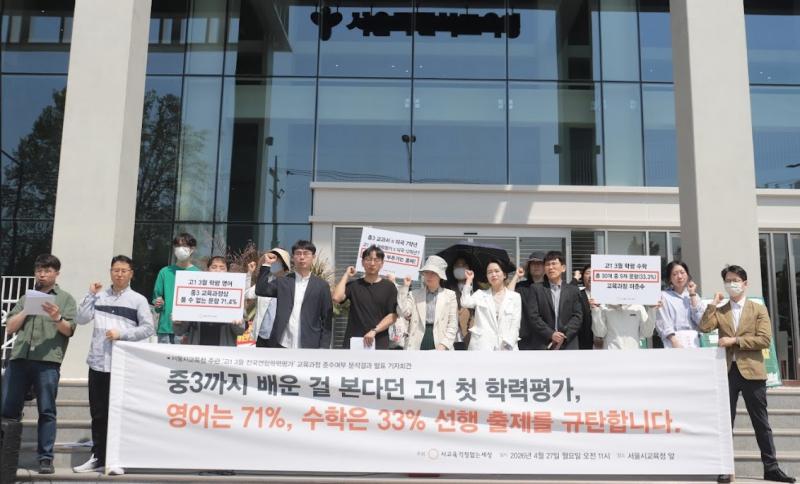
【전북교육신문】사교육걱정없는세상이 2026학년도 고1 3월 전국연합학력평가(학평) 수학·영어 문항을 분석한 결과, 영어는 71%, 수학은 33%의 문항만 중학교 교육과정 범위 안에 있는 것으로 나타났다.
사교육걱정없는세상(이하 사교육걱정)은 2026년 4월 27일(일) 오전 11시 서울시교육청 별관에서 기자회견을 열고, 2026학년도 고1 3월 학력평가 수학·영어 문항의 교육과정 적합성 분석 결과를 발표했다.
수학 영역: 30문항 중 9문항만 적정 분석 결과에 따르면, 수학 영역에서 전체 30문항 중 9문항(33.3%)만이 교육과정 범위 내에 있는 문항으로 확인됐다. 이에 해당하는 문항은 13번, 16번, 18번, 20번, 21번, 24번, 25번, 29번, 30번이다. 나머지 21문항(66.7%)은 '문항 분류 기준표'에 따라 범위를 벗어난 것으로 분류됐다.
교육과정을 벗어난 문항들 중에는 이전 교육과정(2009·2007년 개정)에서만 다루는 내용을 포함한 문항, 2015 개정 교육과정의 상위 과목(고급) 내용을 다루는 문항, 그리고 대학수학(미적분·통계 등) 과목 수준의 문항 등이 포함된 것으로 나타났다.
영어 영역: ATOS 지수 기준 초과 영어 영역의 경우, 전체 28개 지문 중 20개(71.4%)가 교육과정 기준 범위 내에 해당하는 것으로 분석됐다. 그러나 지문 독해 수준을 나타내는 ATOS 지수를 기준으로 분석하면, 전체 28개 지문의 평균 ATOS 지수가 12.63으로 대학교 1학년(AR 12년) 수준에 해당하는 것으로 나타났다.
사교육걱정은 중학교 영어 교육과정 기준 ATOS 지수가 6~중1 수준(AR 6.73~7.17)임을 고려할 때, 이는 6개 학년에 해당하는 수준 차이가 있다고 지적했다. 특히 지문 난이도 분류 기준 'ATOS 환산' 방식을 통해 해당 연도 교과서 수준과의 괴리가 명확하게 드러났다.
중학교 졸업 후 시험인데… 사교육걱정은 "고1 3월 학평은 중학교 교육과정을 마치고 고등학교에 막 입학한 학생들이 처음 치르는 시험"이라며 "그런데도 중학교 교육과정 수준을 크게 초과하는 문항들이 다수 출제되는 것은, 사실상 학원이나 선행학습 없이는 좋은 성적을 내기 어렵다는 것을 의미한다"고 비판했다.
단체는 또 2023년 제정된 '선행교육 금지법(공교육정상화법)'에 따라 공교육 기관이 주관하는 시험에서도 선행학습을 유발하는 문항을 출제해서는 안 됨에도 불구하고, 이를 위반하는 문항들이 버젓이 포함되고 있다는 점을 문제 삼았다.
사교육걱정은 이번 분석을 바탕으로 ▲교육과정 범위 내 출제 원칙 준수 ▲ATOS 환산 기준 등 객관적 난이도 검토 절차 도입 ▲선행학습 유발 문항 신고 체계 실질화 등 제도적 개선 방안 마련을 교육 당국에 촉구했다. 아울러 시도교육청 및 학력평가 주관 기관이 교육과정 적합성 검토 위원회를 내실 있게 운영할 것을 요구했다.
Analysis Results of a World Without Worries about Private Education Revealed: Only 71% of High School Freshmen Meet Middle School Curriculum Standards in English, 33% in Math
A world without worries about private education - An analysis of the March 2026 1st grade national joint academic assessment (Hakpyeong) math and English questions revealed that only 71% of the English questions and 33% of the math questions were within the scope of middle school curriculum.
The Society for a World without Worries about Private Education (hereinafter referred to as the Society) held a press conference on April 27, 2026, at 11 a.m. at the Seoul Metropolitan Office of Education Annex to announce the results of the analysis of the educational suitability of the math and English questions in the March 2026 1st grade academic assessment.
**Math Section: Only 9 out of 30 questions are appropriate**
According to the analysis, out of the total 30 math questions, only 9 questions (33.3%) were found to be within the curriculum range. These questions were numbers 13, 16, 18, 20, 21, 24, 25, 29, and 30. The remaining 21 questions (66.7%) were classified as outside the scope according to the 'Question Classification Criteria.'
Among the questions outside the curriculum were those that included content covered only in previous curriculum revisions (2009, 2007), questions covering advanced topics from the 2015 revised curriculum, and questions at the level of university mathematics (calculus, statistics, etc.).
**English Section: Exceeding ATOS Index Standards**
In the English section, out of 28 passages, 20 (71.4%) were analyzed to be within the curriculum standards. However, based on the ATOS index, which indicates the reading level, the average ATOS index of all 28 passages was 12.63, equivalent to the level of a first-year university student (AR 12 years).
The Society pointed out that considering the middle school English curriculum standard ATOS index is at the level of 6th to 7th grade (AR 6.73-7.17), there is a significant difference of six grades. Particularly, through the 'ATOS Conversion' method of classifying passage difficulty, the discrepancy with the level of the textbook for that year was clearly revealed.
**Exam After Middle School Graduation...**
The Society criticized that the March 1st grade academic assessment is the first test for students who have just entered high school after completing the middle school curriculum, yet many questions significantly exceed the middle school curriculum level, making it difficult to achieve good grades without the help of private academies or preparatory studies.
The group also raised concerns that despite the 'Preparatory Education Prohibition Law (Public Education Normalization Law)' enacted in 2023, questions that induce preparatory studies are included in exams organized by public educational institutions, violating the law.
Based on this analysis, the Society urged educational authorities to establish measures for ▲ adherence to the principle of including questions within the curriculum range ▲ introduction of objective difficulty assessment procedures based on ATOS conversion standards ▲ implementation of a reporting system for questions inducing preparatory studies, and called for substantive improvements in the system. Additionally, they demanded that municipal education offices and academic assessment agencies operate curriculum suitability review committees effectively.
📝 Brief Summary:
An analysis of the March 2026 1st grade national academic assessment in math and English showed that a low percentage of questions were within the middle school curriculum range. The Society for a World without Worries about Private Education criticized the difficulty level of the questions and called for improvements in the system.
🗣️ Natural Korean Translation:
2026년 3월 1학년 국가 학업 평가의 수학과 영어 문제 분석 결과, 영어 문제의 71%와 수학 문제의 33%만 중학교 교육과정 범위 내에 있었음이 밝혀졌다. 사교육에 대한 걱정이 없는 세상을 꿈꾸는 협회는 이러한 문제들의 난이도를 비판하며 체계 개선을 요구했다.
❓ Comprehension Questions:
1. What percentage of the math questions in the March 2026 1st grade national academic assessment were within the curriculum range?
수학 문제 중 2026년 3월 1학년 국가 학업 평가에서 교육과정 범위 내에 있는 문제는 어느 정도인가요?
2. What was the average ATOS index of the English passages in the assessment?
평가에서 영어 지문들의 평균 ATOS 지수는 얼마인가요?
3. Why did the Society criticize the March 1st grade academic assessment?
협회가 3월 1학년 학업 평가를 비판한 이유는 무엇인가요?
💡 Vocabulary Learning:
1. academic (학업, adjective)
- relating to education or scholarship
- 학문이나 교육과 관련된
- She received an academic award for her research.
- 그녀는 연구로 학업상을 받았다.
2. curriculum (교육과정, noun)
- the subjects comprising a course of study in a school or college
- 학교나 대학의 과정으로 이루어진 과목
- The new curriculum includes more practical training.
- 새 교육과정에는 더 많은 실습 훈련이 포함되어 있다.
3. assessment (평가, noun)
- the act of evaluating or judging the quality, importance, amount, or value of something
- 무언가의 품질, 중요성, 양 또는 가치를 평가하거나 판단하는 행위
- The assessment of the project was very positive.
- 그 프로젝트의 평가는 매우 긍정적이었다.
4. discrepancy (불일치, noun)
- a difference between two things that should be the same
- 두 가지 사이의 같아야 하는 것들 간의 차이
- There was a discrepancy between the two reports.
- 두 보고서 사이에 불일치가 있었다.
5. violation (위반, noun)
- an action that breaks or acts against a law, rule, or agreement
- 법, 규칙 또는 협정을 어기거나 반대하는 행위
- The company was fined for violation of safety regulations.
- 그 회사는 안전 규정 위반으로 벌금을 부과받았다.

💬 댓글 (0)
댓글을 작성하려면 로그인이 필요합니다.
로그인첫 댓글을 작성해보세요!