【전북교육신문】재생에너지 전환과 초고압 송전선로 건설을 둘러싼 사회적 갈등이 지방선거 핵심 이슈로 떠오른 가운데, 전북지역 광역단체장 후보들이 정부의 일방적인 송전망 정책에 제동을 걸고 용인 반도체 국가산단 재검토 필요성에 공감대를 형성했다.
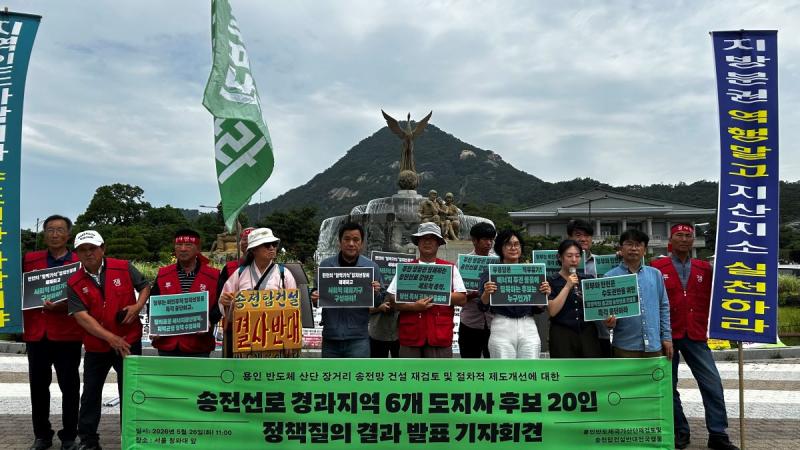
용인반도체국가산단재검토및송전탑건설반대전국행동(전국행동)은 26일 오전 청와대 앞에서 기자회견을 열고, 송전선로 경과지역 6개 광역도지사 후보 20명을 대상으로 실시한 정책질의 결과를 공개했다. 이번 질의는 △용인 반도체 국가산단 재검토 △비민주적 입지선정위원회 개선 △사회적 대화기구 구성 △지자체 권한 행사 등 4개 분야를 중심으로 진행됐다.
전국행동에 따르면 응답 후보의 40% 이상이 정부와 한국전력공사의 초고압 송전선로 건설 계획에 대해 “전면 재검토가 필요하다”는 입장을 밝혔다. 특히 주민 의견을 대변할 ‘민관합동 TF 설치’와 함께, 송전선로 건설을 유도하기 위해 지급되는 ‘km당 약 20억 원 규모 특별지원사업비’ 제도의 폐지·개편에도 다수가 동의했다.
전북에서는 더불어민주당 이원택 후보, 진보당 백승재 후보, 무소속 김관영 후보가 정책질의 11개 항목에 대해 전폭적인 동의 의사를 밝히며 강경 대응 방침을 예고했다. 세 후보는 수도권 전력 집중을 심화시키는 용인 반도체 국가산단 계획을 재검토해야 하며, 대규모 전력 수요 기업을 새만금 등 재생에너지 기반이 풍부한 지역으로 분산 배치해야 한다는 데 의견을 같이했다.
이들 후보는 또한 제도 개선 전까지 전북 내 초고압 송전선로 입지선정 절차를 잠정 중단하고, 한전의 위법·부당행위 여부를 조사해야 한다고 주장했다. 주민 동의 없는 보상 협약에 대해서는 도지사가 직접 제동을 걸고, 정부에 제도 폐지를 요구하겠다는 입장도 밝혔다.
당선 이후 구체적인 실행 계획도 제시됐다. 세 후보는 송전탑 반대 주민대책위가 참여하는 ‘도지사 직속 송전탑 갈등 대응 민관합동 TF’를 설치하고, 타 시·도와 연대한 ‘송전망 문제 해결 시도지사협의회’ 구성을 추진하겠다고 약속했다.
전국행동은 이날 기자회견에서 정부의 “국가 경쟁력 확보를 위한 불가피한 사업”이라는 논리를 정면 비판했다. 배슬기 전국행동 집행위원은 “독일 등 선진국은 사업 초기부터 주민 참여와 공론화를 제도화하고 있지만, 우리 정부는 사실상 보상금으로 주민 수용을 압박하고 있다”며 “이번 후보들의 동의는 단순 민원이 아니라 분산형 에너지 체계로 전환하라는 민심”이라고 주장했다.
반면 정책질의에 응답하지 않은 국민의힘 양정무 후보를 향한 비판도 거세졌다. 전북대책위는 양 후보가 초고압 송전탑 문제에 침묵한 채 ‘새만금 원전 건설’ 공약을 내세웠다며 강하게 반발했다.
이정현 전북대책위 공동집행위원장은 “새만금 원전 공약은 전북이 추진해온 재생에너지 기반 구축과 RE100 산업단지 전략을 정면으로 부정하는 것”이라며 “원전 건설은 또 다른 장거리 송전선로 갈등을 초래할 수밖에 없다”고 비판했다.
완주 송전탑건설백지화추진위 박성래 위원장도 “주민들은 2년 넘게 생존권을 지키기 위해 싸워왔다”며 “새 지방정부는 한전이 아니라 주민 편에 서야 한다”고 강조했다.
전국행동은 선거 이후에도 당선자들의 정책 이행 여부를 지속적으로 감시하겠다고 밝혔다. 안재훈 전국행동 집행위원장은 “송전선로 건설 잠정 중단과 갈등 전수조사를 위한 사회적 대화기구 구성을 강하게 요구할 것”이라며 “정부가 기존 방식의 불통 행정을 이어간다면 전국적 연대 투쟁에 직면하게 될 것”이라고 경고했다.
North Jeolla Province Governor Candidates Unanimously Call for Reevaluation of Yongin Semiconductor Industrial Complex and Resolution of Power Line Conflict
Social conflicts surrounding the transition to renewable energy and the construction of ultra-high voltage transmission lines have emerged as key issues in local elections, with candidates for regional metropolitan mayors in the Jeonbuk region expressing consensus on the need to review the government's unilateral transmission network policy and the necessity to reevaluate the construction of the Yongin Semiconductor National Industrial Complex.
The Nationwide Action for Reevaluation of the Yongin Semiconductor National Industrial Complex and Opposition to Transmission Tower Construction (Nationwide Action) held a press conference in front of the Blue House on the morning of the 26th, revealing the results of policy inquiries conducted with 20 candidates for governor from 6 metropolitan provinces in the affected transmission line areas. The inquiries focused on four main areas: △ reevaluation of the Yongin Semiconductor National Industrial Complex △ improvement of undemocratic site selection committees △ establishment of social dialogue mechanisms △ exercise of local government authority.
According to the Nationwide Action, more than 40% of responding candidates expressed the view that a "comprehensive reevaluation is necessary" regarding the government's and Korea Electric Power Corporation's plans for the construction of ultra-high voltage transmission lines. In particular, many also agreed on the abolition or revision of the system of 'special support project funds of approximately 20 billion won per km' paid to induce the construction of transmission lines, along with the establishment of a 'civil-military joint task force' to represent residents' opinions.
In Jeonbuk, candidates from the Democratic Party of Korea, Progressive Party, and an independent candidate expressed full agreement on 11 policy items, announcing a firm response policy. The three candidates agreed that the plan for the Yongin Semiconductor National Industrial Complex, which intensifies power concentration in the capital region, should be reevaluated, and large-scale power-demanding companies should be dispersed to regions abundant in renewable energy such as Saemangeum.
The candidates also argued that until institutional improvements are made, the preliminary site selection process for ultra-high voltage transmission lines in Jeonbuk should be temporarily suspended, and an investigation should be conducted into the illegality and unfair practices of Korea Electric Power Corporation. They also stated that in the case of compensation agreements without residents' consent, the governor should directly intervene and demand the government to abolish the system.
Concrete implementation plans were also presented after the election. The three candidates promised to establish a 'civil-military joint task force for conflict resolution of transmission towers directly under the governor's office, involving the participation of the anti-transmission tower residents' committee, and to promote the formation of a 'Governors' Council for Solving Transmission Network Issues' in collaboration with other cities and provinces.
During the press conference on that day, the Nationwide Action directly criticized the government's logic of "inevitable projects for securing national competitiveness." Baek Seul-gi, a member of the Nationwide Action's executive committee, stated, "Advanced countries like Germany have institutionalized citizen participation and public discourse from the early stages of projects, but our government is essentially pressuring residents to accept with compensation payments," arguing that the candidates' agreement this time is not just a simple petition, but the public sentiment calling for a transition to a decentralized energy system.
On the other hand, criticism against the People Power Party candidate Yang Jung-mu, who did not respond to the policy inquiries, intensified. The Jeonbuk Countermeasure Committee strongly opposed Yang's silence on the ultra-high voltage transmission tower issue while promoting the 'Saemangeum nuclear power plant construction' pledge.
Jeong Hyeon, co-executive director of the Jeonbuk Countermeasure Committee, criticized the 'Saemangeum nuclear power plant pledge' as a direct denial of Jeonbuk's efforts to establish a renewable energy-based infrastructure and RE100 industrial complex strategy, stating that nuclear power plant construction will inevitably lead to another long-distance transmission line conflict.
Park Seong-rae, chairman of the Wanju Transmission Tower Construction Blanket Cancellation Promotion Committee, emphasized, "Residents have been fighting for over two years to protect their right to survival," and stressed that the new local government should stand on the side of the residents, not Korea Electric Power Corporation.
The Nationwide Action stated that they will continue to monitor the implementation of elected officials' policies even after the election. Ahn Jae-hoon, executive director of the Nationwide Action, warned, "We will strongly demand the temporary suspension of transmission line construction and the establishment of a social dialogue mechanism for a comprehensive investigation of conflicts," adding, "If the government continues its ineffective administration, it will face a nationwide solidarity struggle."
📝 Summary:
Social conflicts have arisen in local elections in the Jeonbuk region due to the transition to renewable energy and the construction of ultra-high voltage transmission lines. Candidates for regional mayors expressed consensus on the need to review the government's transmission network policy and reevaluate the construction of the Yongin Semiconductor National Industrial Complex.
🗣️ Korean Translation:
전북 지역 지방 선거에서 재생 에너지로의 전환과 초고압 송전선 건설로 인한 사회 갈등이 발생했습니다. 지역 시장 후보들은 정부의 전송망 정책을 재검토하고 용인반도체 국가산단 건설을 재평가해야 한다는 데에 공감을 표현했습니다.
❓ Comprehension Questions:
1. What are some key issues in local elections in the Jeonbuk region?
전북 지역 지방 선거에서 어떤 주요 이슈들이 발생했나요?
2. What did more than 40% of responding candidates express regarding the construction of ultra-high voltage transmission lines?
응답한 후보자들 중 40% 이상이 초고압 송전선 건설에 대해 어떻게 표현했나요?
3. What did candidates from the Democratic Party of Korea, Progressive Party, and an independent candidate agree on regarding the Yongin Semiconductor National Industrial Complex?
대한민국 민주당, 진보당, 그리고 무소속 후보자들은 용인반도체 국가산단에 대해 어떤 점에 동의했나요?
💡 Vocabulary Learning:
1. consensus, 합의, noun
- general agreement among a group of people
- 사람들 사이의 일반적인 합의
- There was a consensus among the students to extend the deadline for the project.
- 학생들 사이에 프로젝트 기한을 연장하기로 한 합의가 있었습니다.
2. reevaluate, 재평가하다, verb
- to assess or evaluate again
- 다시 평가하거나 검토하는 것
- The company decided to reevaluate their marketing strategy after poor sales results.
- 회사는 판매 실적이 좋지 않아 마케팅 전략을 재평가하기로 결정했습니다.
3. abolish, 폐지하다, verb
- to officially end a law, system, or institution
- 공식적으로 법, 제도, 혹은 기관을 종료시키는 것
- The government decided to abolish the outdated policy.
- 정부는 구식 정책을 폐지하기로 결정했습니다.
4. intensify, 강화하다, verb
- to become stronger or more extreme
- 더 강해지거나 극단적이 되는 것
- The storm is expected to intensify as it moves closer to the coast.
- 폭풍은 해안에 가까워짐에 따라 더 강해질 것으로 예상됩니다.
5. intervene, 개입하다, verb
- to become involved in a situation to change what is happening
- 상황에 개입하여 일어나고 있는 일을 변경하는 것
- The teacher had to intervene when the students started arguing in class.
- 학생들이 수업 중에 말다툼을 시작하자 선생님은 개입해야 했습니다.

💬 댓글 (0)
댓글을 작성하려면 로그인이 필요합니다.
로그인첫 댓글을 작성해보세요!