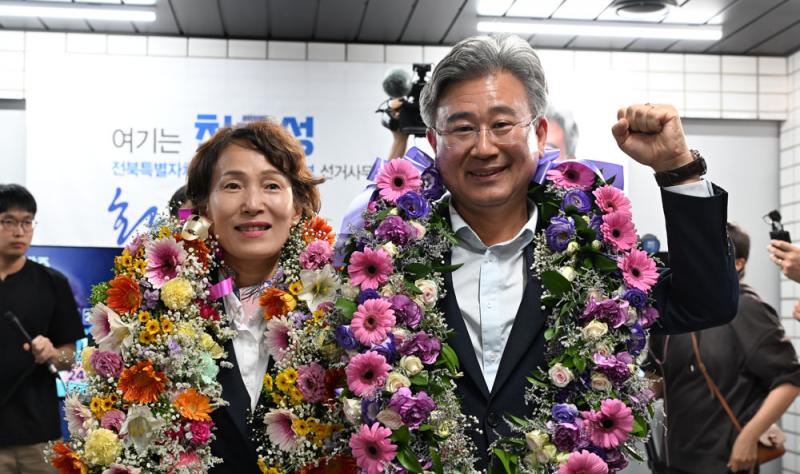
Cheon Hoseong (59) was elected as the Superintendent of Education for Jeollabuk-do in the nationwide local elections on June 4th. Overcoming competition from Lee Namho, Cheon won the people's choice, opening a new chapter in educational innovation in Jeollabuk-do.
In his acceptance speech, Cheon expressed that his election was not just a personal victory but a mandate from the people to change education in Jeollabuk-do. He emphasized the urgent task of rebuilding trust in the shattered educational community and indicated his willingness to actively embrace good policies from competing candidates.
<b>Educational Philosophy Forged on the Frontlines</b>
Born in Gochang, Jeollabuk-do in 1967, Cheon graduated from Jeonla High School and Jeonbuk National University's College of Education, majoring in social education. He taught for 15 years at schools like Haeryo High School, Jeonju Girls' High School, and Iri High School. He later obtained a Ph.D. in Education specializing in curriculum research from Nagoya University in Japan and served as a professor at Jeonju National University of Education for 20 years, visiting school sites over 500 times, establishing himself as an education expert combining theory and practice.
<b>Prominent Role in National Education Policy</b>
Cheon has been deeply involved in national policy-making beyond the education sector. He worked as an education special envoy for President Moon Jae-in's campaign and contributed to bridging educational disparities between regions as an advisory member of the Presidential National Balanced Development Commission. Currently, he serves as the co-representative of the National Association for Educational Autonomy Innovation, advocating for expanded educational autonomy.
<b>Leading Figure in the Democratic and Progressive Education Camp</b>
In the 2022 Superintendent of Education election, Cheon, who was selected as the sole candidate through the Jeollabuk-do Democratic Progressive Education Superintendent Selection Committee, consisting of over 200 civil society organizations and 120,000 participants, narrowly lost by about 3%. However, after four years of preparation, he finally secured the people's choice in this election. Having led the Jeollabuk-do Movement Headquarters for the resignation of Park Geun-hye and Yoon Suk-yeol, he garnered strong trust from the progressive civil society, leading to his victory in this election.
<b>Five Key Tasks</b>
Cheon expressed his intention to focus on five key tasks during his term.
Firstly, he aims to strengthen basic academic skills by establishing a dense learning safety net to ensure that no student is left behind in learning, providing a foundation for all children to discover their potential and grow.
In the field of career education, he promised significant innovation, moving away from the uniform competition centered on Seoul metropolitan area admissions, towards personalized education that respects each student's aptitude and dreams. He plans to establish a systematic career design encompassing elementary, middle, and high school levels to organically connect further education, employment, and entrepreneurship.
Support for rural areas and small schools facing the threat of depopulation is also crucial. Under the belief that education is the most potent force in overcoming regional extinction, he emphasized creating an educational ecosystem where regions and schools grow together, making Jeollabuk-do self-sufficient and preventing residents from leaving.
To realize clean educational administration, he pledged to establish a robust integrity system to prevent corruption and irregularities in personnel, budget, and contracts, firmly stating that no privileges or violations will be tolerated.
Lastly, he prioritized the restoration of trust in the shattered educational community as the most critical task. Cheon stated that building a community where educators, parents, students, schools, education offices, and local communities trust and cooperate with each other was the most solemn demand conveyed by the people in this election.
<b>Rising Expectations for a New Era in Jeollabuk-do</b>
As Cheon Hoseong and Lee Wontaek, the newly elected Governor of Jeollabuk-do, usher in the era of leaders in their 50s for metropolitan cities, expectations are high for dynamic changes in politics and education in Jeollabuk-do. Cheon vowed, "I will never walk the path of the Superintendent of Education alone" and promised to repay the people's trust with concrete results.
📝 Summary:
Cheon Hoseong was elected as the Superintendent of Education for Jeollabuk-do after winning the people's choice in the local elections. He expressed his commitment to changing education in the region and emphasized the need to rebuild trust within the educational community.
🗣️ Natural Korean translation:
천호성(59세)씨가 6월 4일 전국 지방선거에서 전라북도 교육감으로 당선되었습니다. 그는 지역 사람들의 선택을 이겨내며 새로운 교육 혁신 시대를 열었습니다. 그는 그의 당선이 개인적인 승리뿐만 아니라 전라북도 교육을 변화시키기 위한 국민의 명령이라고 밝혔습니다.
❓ Comprehension questions:
1. Who was elected as the Superintendent of Education for Jeollabuk-do?
누가 전라북도 교육감으로 당선되었나요?
2. What did Cheon express in his acceptance speech?
천호성은 당선 연설에서 무엇을 표현했나요?
3. What are the five key tasks that Cheon aims to focus on during his term?
천호성이 임기 동안 집중할 다섯 가지 주요 업무는 무엇인가요?
💡 Vocabulary learning:
1. mandate (명령, noun)
- An official order to do something.
- 사무를 처리하라는 공식적인 명령.
- The new law includes a mandate for all citizens to wear seat belts.
- 새로운 법은 모든 시민이 안전벨트를 착용하도록 명령하고 있습니다.
2. autonomy (자주권, noun)
- The right or condition of self-government.
- 자가 정부권의 권리 또는 상태.
- The region was granted autonomy to make its own decisions.
- 그 지역은 자신의 결정을 내릴 자율성을 부여받았습니다.
3. innovation (혁신, noun)
- The introduction of new ideas, methods, or products.
- 새로운 아이디어, 방법 또는 제품의 도입.
- The company is known for its constant innovation in technology.
- 그 회사는 기술 분야에서 지속적인 혁신으로 유명합니다.
4. solemn (엄숙한, adjective)
- Formal and dignified.
- 엄숙하고 존엄한.
- The ceremony was a solemn occasion attended by many important figures.
- 그식은 많은 중요 인물들이 참석한 엄숙한 행사였습니다.
5. depopulation (인구 감소, noun)
- The reduction in the number of people living in a particular area.
- 특정 지역에 거주하는 사람 수의 감소.
- The government is implementing policies to address rural depopulation.
- 정부는 시골 인구 감소에 대응하기 위한 정책을 시행하고 있습니다.

💬 댓글 (0)
댓글을 작성하려면 로그인이 필요합니다.
로그인첫 댓글을 작성해보세요!