The demand for the reinstatement of Lee Young-joo, a former secretary-general of the Korean Confederation of Trade Unions (KCTU) and a member of the Korean Teachers and Education Workers' Union (KTU), continues to be voiced. This teacher legally regained her civil service reinstatement rights through a pardon in December 2021, but has not been able to return to the classroom even after about three years have passed.
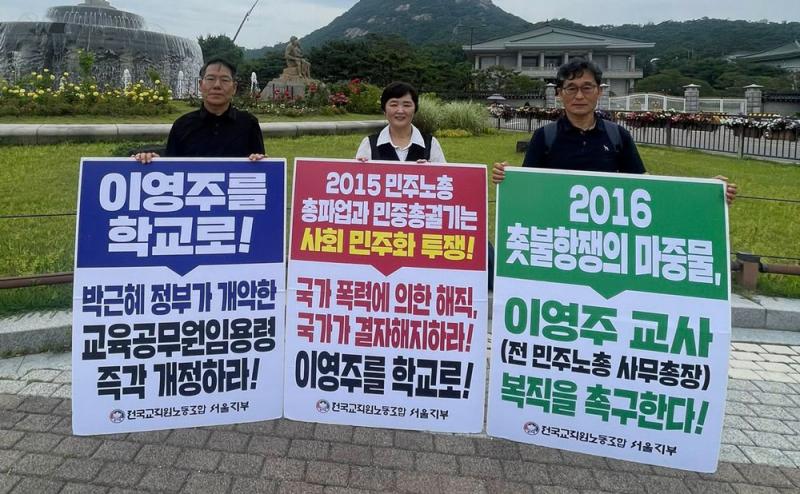
On May 11, the National Association of Educational Workers held a press conference in front of the Sarangchae in Jongno-gu, Seoul, urging the immediate reinstatement of Lee Young-joo. The KTU criticized the reality that, despite legally regaining civil service reinstatement rights, she is still unable to return to the classroom, calling it an administrative neglect that undermines the purpose of the pardon.
Lee Young-joo has been involved in the education sector since her appointment at Tongyeong Middle School in 1980, and she participated in the establishment of the KTU in 1989. At that time, she was dismissed for her involvement in the founding of the KTU as the inaugural director of the Gyeongnam branch and was reinstated in 1998.
Even after reinstatement, she continued her activities with the KTU. From 2013 to 2014, she served as the senior vice-chair of the KTU, and in November 2014, she was elected as the 11th secretary-general of the 8th term of the KCTU. She was also the first female secretary-general of the KCTU.
However, in 2014, she was indicted for leading protests against the government's policy of excluding the KTU from legal labor unions and for activities such as declaring a teacher strike. She was then indicted in December 2017 for leading illegal and violent protests and was dismissed in 2019.
The KTU views the dismissal of Lee Young-joo not just as an individual issue but as a symbolic case where legitimate trade union activities and actions for the realization of democracy have led to dismissal.
The government pardoned and reinstated Lee Young-joo in December 2021, thereby restoring her legal civil service reinstatement rights. However, her reinstatement has not yet been realized.
The obstacle to reinstatement lies in Article 9 of the Education Civil Servants Appointment Order, which allows reappointment only within three years from the last retirement date, creating another barrier for teachers who have been dismissed for an extended period.
The KTU stated, "The relevant laws, including the Education Civil Servants Appointment Order, preventing the reinstatement of dismissed teachers, must be amended immediately," and emphasized that "it is unfair for a teacher who has regained legal rights through a pardon to be unable to return to the classroom due to administrative regulations."
At the press conference on May 11, Lee Young-joo defined her reinstatement struggle as "labor education by dismissed teachers."
She said, "I lived as a dismissed person for ten years. I thought it was okay," and stated, "At that time in 2015, I fought under the name of the KCTU to address the poor working conditions faced by students and young people, the KTU being excluded from legal labor unions, and the issues of the Sewol ferry disaster."
She continued, "Through the KCTU's general strike and the people's uprising, we fought against the labor repression of the Park Geun-hye government, the destruction of people's livelihoods, the erosion of democracy, the nationalization of Korean history textbooks, and the cover-up of the truth about the Sewol ferry disaster," and said, "I thought that by creating the resignation of Park Geun-hye with the citizens in the square, Korean society took a step forward in democracy. So, I thought my role was sufficient, but it was not enough."
She emphasized, "If one is dismissed for trade union activities, it is not a society that respects labor, and if one is dismissed for representing the voices of workers and citizens, it is not democracy."
Furthermore, she stated, "I will continue the reinstatement struggle to ensure that no one is dismissed for the same reasons," adding, "The reinstatement struggle is labor education by dismissed teachers and a democratic lesson conducted by teachers without classrooms."
She concluded, "I hope for the day when teaching in a classroom is no longer just a dream but a reality to come quickly," and said, "Only then will it be true democracy, only then will it be respect for labor, and that is justice."
"Responsibility for my dismissal and delayed reinstatement lies with the current government"
Lee Young-joo argued that the current government also bears responsibility for her dismissal and delayed reinstatement.
She said, "In the past, it was the Park Geun-hye government that issued a warrant for my arrest and detained me, but today, I am a dismissed person because of the current government's responsibility," adding, "The current government and Lee Jae-myung administration must answer what kind of country South Korea is today."
Her statement implies that the issue of delayed reinstatement after pardon and restoration of legal rights cannot be seen solely as a problem of past oppression by the previous administration. If reinstatement to the classroom is obstructed due to administrative and institutional barriers even after legal rights have been restored, the responsibility to resolve this lies with the current government and educational authorities.
"The torchbearer of the Candlelight Revolution, the people's uprising is innocent"
Lee Young-joo's reinstatement struggle is deeply connected to the historic significance of the Candlelight Revolution in 2016. Supporters are urging her reinstatement under the slogan, "The torchbearer of the Candlelight Revolution, the people's uprising is innocent."
The KCTU's general strike and the people's uprising in 2015 were popular resistance movements against the labor repression, people's livelihood crisis, retreat of democracy, nationalization of Korean history textbooks, and the cover-up of the truth about the Sewol ferry disaster by the Park Geun-hye government. Subsequently, citizens gathered in the square holding candles, leading to the impeachment of former President Park Geun-hye.
Lee Young-joo's reinstatement is not just about the restoration of one teacher's honor. It is about correcting anti-labor practices that lead to oppression and dismissal for legitimate union activities and social resistance.
"To return to the classroom before retirement next year"
Given that Lee Young-joo will reach retirement age next year, there is not much time left for her to be with students in the classroom until the end. Prompt reinstatement is necessary to allow her to finish her final teaching years with students.
Noh Byeong-seop, a former director of the KCTU's Jeonbuk branch, posted a photo on Facebook of himself participating in a picket with Lee Young-joo, stating, "Teacher Lee Young-joo must be reinstated," and said, "34 people were dismissed together due to the KTU's involvement in an illegal labor union, but only Teacher Lee Young-joo has not been able to return to the classroom yet." He further expressed, "She will reach retirement age next year," and appealed, "Much attention and solidarity are needed to allow her to finish her last teaching years with students."
He also mentioned, "Teacher Lee Young-joo was arrested and dismissed for leading the people's uprising, which was the torchbearer of the Candlelight Revolution," and pointed out, "Despite the pardon and restoration of rights, she has not been allowed to return to the classroom."
Reinstatement is not just an individual issue but a matter of democracy
The reinstatement of Lee Young-joo is not just about the restoration of one teacher's status. If labor union activities, representation of the rights of social minorities and citizens, and participation in the restoration of democracy lead to dismissal and exclusion, this goes against the society that the country seeks, which respects labor.
The demonstrators in front of the Blue House demanding Lee Young-joo's reinstatement state, "It is the minimum duty of the country to allow a teacher who has dedicated her life to realizing the values of education and labor to regain her honor and retire by the side of students."
Lee Young-joo said at the press conference, "A society where those who dedicate themselves to creating a better world do not suffer will progress a little faster," and expressed, "I hope my reinstatement will be a catalyst for one step forward in our society."
The issue of Lee Young-joo's reinstatement now goes beyond an individual's past events and remains a challenge for Korean society on how it will treat those who have dedicated themselves to labor union activities and democracy.

💬 댓글 (0)
댓글을 작성하려면 로그인이 필요합니다.
로그인첫 댓글을 작성해보세요!