The incident that occurred in a 6th-grade classroom at M Elementary School in Jeonju was not just a simple conflict between a teacher and parents. At its core were two students who became fearful of the school. The decision of non-indictment by the Jeonbuk Provincial Police Agency on June 4, 2026, regarding two parents is now shedding light on the 'malicious complaints' frame that had been raised around this incident.
The police concluded that there was insufficient evidence to support any of the charges of obstruction of official duties, obstruction of hierarchical official duties, defamation, and injury filed against parents A and B. The criminal frame of 'malicious complaints' that the teacher's side had been claiming has not been proven by the investigative agency's judgment.
This decision is not just a document determining the criminal responsibility of the two parents. It is a starting point to question what actually happened in the 6th-grade classroom at M Elementary School, who was not protected, and why the children became fearful of the school.
**Teacher who reported parents became homeroom teacher**
The core of the incident begins with the homeroom assignment for the new school year in 2025.
After a PD Notebook broadcast on November 5, 2024, Teacher C publicly announced on his social media at the end of November 2024 that he had applied for a transfer to Jeonju M Elementary School. It was revealed that if assigned to that school, he would become the homeroom teacher of the so-called 'PD Notebook class.'
#1
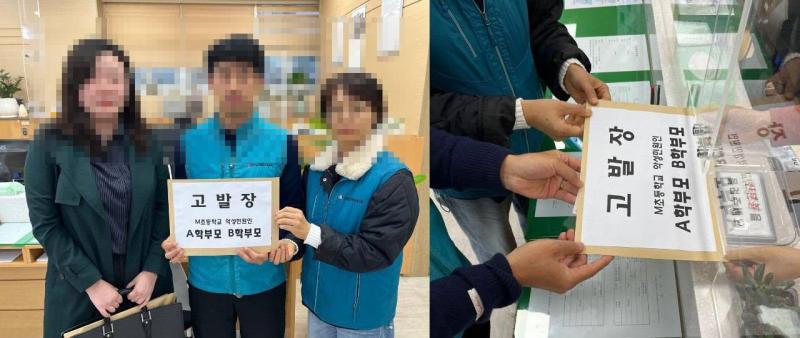
In December 2024, Teacher C reported the parents of those students to the authorities. He even publicly shared the process of receiving the report and related photos, revealing the legal response.
About two months later, in mid-February 2025, Teacher C actually received a transfer order to Jeonju M Elementary School. And on March 1, 2025, he was assigned as the homeroom teacher for the class that included the children of the parents he had reported.
Given these developments, it is not enough to explain the core of the incident simply as "Teacher C became the homeroom teacher because no one else wanted to take the position." What needs to be confirmed first is the sequence of events such as ▲ transfer application ▲ public announcement of homeroom intention ▲ reporting parents to authorities ▲ publicizing on social media ▲ school assignment ▲ homeroom assignment for those students.
Especially, if a teacher who had already reported parents to the authorities publicly disclosed the transfer to that school and expressed the intention to become the homeroom teacher of that class, it raises the possibility that other teachers found it difficult to support the homeroom assignment for that class.
Ultimately, the crucial issue in this matter is not just about "whether there was no one to take the homeroom position," but rather why a teacher who reported parents became the homeroom teacher for those students, and whether that process was appropriate from a student protection and educational perspective.
**Child called the police directly**
In the new school year of 2025, two students entered the 6th-grade classroom and were shocked to see the face of their homeroom teacher. The person standing at the podium was the teacher who had reported their mothers to the police.
After that, the children found it difficult to even enter the classroom. One student hid in their mother's car trunk and refused to come out, while B's child pressed the smartwatch during class to directly report to the police.
The police non-indictment decision clearly records the events of the police being dispatched to the school on March 17, 2025.
"On the same day in the morning, B's child student first reported with the (police-issued) smartwatch, and the police officer arrived on the scene and concluded the incident."
This can be seen as meaning that the child felt so fearful that they had to call the police themselves during class. The incident reported by the parents via text was classified as 'non-dispatch,' meaning the police did not respond. Instead, the school took actions such as reporting the parents of a student who was in the schoolyard fearing to enter the classroom for child neglect.
In the decision, the police officers unanimously stated, "There is no fact that the police officers were hindered in their official duties." Therefore, claims like "classes were disrupted every time there was a report" or "parents disrupted school operations by calling the police" are far from the police's judgment. While the teacher and school side argued that the police response delayed their duties, the police deemed there was insufficient evidence to acknowledge obstruction of official duties.
**Not all teachers were feared**
So, did the two students fear all teachers and school life in general equally? Not quite.
B's child transferred to another school and entered middle school. According to the testimony of the middle school officials, the homeroom teacher of that student evaluated the child as a model student. School administrators also informed another teacher they knew that Parent B actively cooperated with school operations as a member of the school operating committee.
This shows that the difficulty faced by that student did not stem from a fear of all teachers or school life in general. What the child feared was not the 'teachers in general,' but rather the specific situation of having a teacher related to the Y Elementary Red Card incident and the teacher who reported their mother to the police as their homeroom teacher.
On the other hand, A's child, who could not transfer, suffered even more. They sustained an injury to the forehead during a school physical activity, and their mental health worsened, leading to absenteeism and eventually being graded as unpaid due to not fulfilling the required number of school days.
This passage clearly shows the essence of the incident. The problem was not that the students rejected school life itself. They could continue their school life in an environment where they felt safe. However, the classroom where a teacher who reported their parents became the homeroom teacher turned into a space of fear for the children, rather than a place of learning.
**Scenes left in the September diary of the classroom**
Even as time passed, the child's anxiety did not disappear. One student wrote in their diary on September 16, 2025:
"I felt unjust because I was asked to solve the math unit test alone since I didn't take a graduation photo... During English class, a KakaoTalk message asking 'How much does it cost to sue?' appeared on the electronic board, and the homeroom teacher hastily erased it."
The child's diary entry is not just a simple expression of emotions. It is a record showing what the child saw and felt in that classroom. It cannot be ignored whether the school was a safe space for the child, and whether the homeroom assignment was a decision that fully considered the student's emotions and right to learn.
**In 2026, a 'homeroom unassigned' frame was created**
Controversy continued during the homeroom assignment phase in 2026. The union related to Teacher C operated under the assumption that no homeroom teacher would be assigned to that class at M Elementary School, holding press conferences and protests. It was also reported that consent forms requesting administrative measures in case of a 'homeroom vacancy' were sent to the candidates for the education superintendent.
However, in reality, a new homeroom teacher had already been assigned to that class the day before the dispatch of the official letter. The union still sent a letter assuming a 'vacancy in case of homeroom unassignment' the day after the homeroom assignment was completed.
As a result, the 'homeroom unassigned' frame in 2026 turned out to be inconsistent with reality. With the actual homeroom assignment in place, the narrative of the class being 'unwanted by anyone' as claimed by the union lost its credibility.
**What did the label 'malicious complaints' erase?**
Elementary school teachers and educational organization executives in Jeonbuk have classified this incident as a 'malicious complaints' issue. However, the police's decision of non-indictment at least shows that this frame was not proven in the criminal proceedings.
Teacher C has stated, "I reported to protect educational activities from parents who engaged in baseless child abuse reports and malicious complaints." Such claims and actions by the teacher's side do not necessarily mean innocence in a criminal sense. However, it is a clear fact from the police investigation that the parents' actions were not recognized as criminal offenses.
Of course, educational activities of teachers should be protected. If a teacher is suffering from repeated complaints, there should be institutional responses. However, the pretext of protecting educational activities should not be used in a way that erases the fear and infringement of students' right to learn.
What was erased in this case were the realities of the two students. One student transferred, and the other student, who could not transfer, experienced worsened mental health and absenteeism due to the teacher who reported their parents becoming the homeroom teacher. The question of what psychological pressure the children felt in the classroom where the teacher who reported their parents became the homeroom teacher, and why the school and education authorities did not foresee and prevent that danger, has been pushed aside.
The term 'malicious complaints' is powerful. However, the more powerful the word, the more cautiously it should be used. If unproven legal matters were labeled as malicious complaints and demanded agreement from candidates during an election period, it could lead to the politicization of education community recovery rather than actual resolution of conflicts.
**Protection of educational activities and student protection must go hand in hand**
The incident in the 6th-grade classroom at M Elementary School cannot be resolved by pitting the protection of educational activities against student protection. Teachers should be protected, but students should also be protected. No one's rights should become a pretext for inflicting pain on others.
Especially, the core of this incident lies in the fact that the two students did not fear all teachers equally. One student continued their school life positively after transferring, while the other student, in an environment where the teacher who reported their parents became the homeroom teacher, experienced worsening mental health and unpaid status. This difference shows that the problem was not the student's personal maladjustment but rather the inadequacy of the educational environment and homeroom assignment.
The Jeonbuk Education Office must now not just handle this matter as a simple dispute over educational authority or complaints. They need to thoroughly examine the 2025 homeroom assignment process, student protection measures, the factual relationship of the 2026 homeroom unassigned frame, and the remaining administrative responsibilities after the police non-indictment decision.
What happened in the 6th-grade classroom at M Elementary School is becoming clearer. A teacher who reported parents came in as the homeroom teacher, and the children expressed fear. This fear was not about all teachers but arose from specific homeroom assignment and subsequent school responses.
The police's decision of non-indictment is now prompting a reevaluation of this incident. It is necessary to look beyond the label of 'malicious complaints' and address the time the students spent in transfer, treatment, unpaid status, and fear that were hidden behind that label. To restore the educational community, it is essential to ask why the children were not protected in that classroom.


💬 댓글 (0)
댓글을 작성하려면 로그인이 필요합니다.
로그인첫 댓글을 작성해보세요!