<b>Jeonbuk's Metropolitan Transportation System Welcomes a New Era</b>
The amendment to the "Special Law on Metropolitan Transportation Management in Metropolitan Areas (hereinafter referred to as the Metropolitan Area Law)" has passed the National Assembly, including Jeonju in the legal metropolitan area, enabling the region to receive government support for metropolitan transportation projects. Previously excluded from the metropolitan area, Jeonbuk had been developing its transportation infrastructure solely with its own budget. This amendment is seen as a significant turning point for regional balanced development.
Jeonbuk Governor Kim Kwan-young stated, "The passage of the Metropolitan Area Law will be a significant opportunity to substantially change the lives of residents," adding, "Improvements in commuting, proximity to jobs, increased access to culture and healthcare will significantly enhance the quality of life for residents." He emphasized the thorough preparation for subsequent procedures to bring about tangible changes in the transportation environment that residents can feel, focusing on incorporating the metropolitan transportation implementation plan.
<b>Connecting Jeonju, Iksan, Gimje, Wansu...as One Living Zone</b>
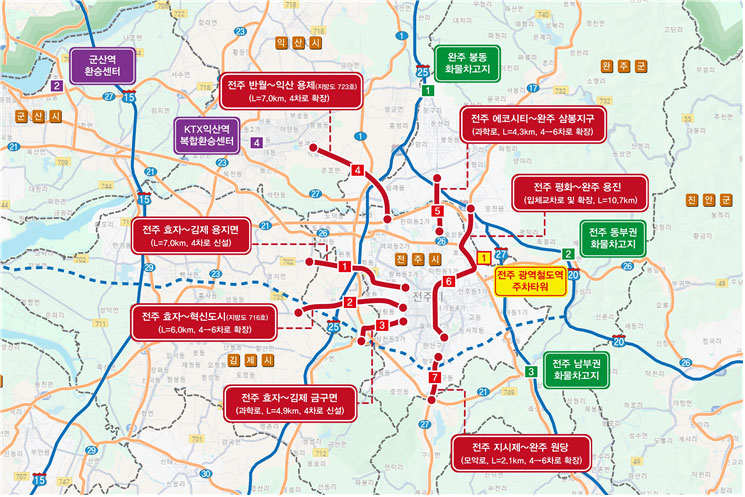
With the amendment to the Metropolitan Area Law, Jeonbuk can now receive government support for expanding the metropolitan transportation network based on the same criteria as existing metropolitan areas like Seoul and Busan. This is expected to lead to the full-scale implementation of the metropolitan transportation network construction project connecting major cities in the province such as Jeonju, Iksan, Gimje, and Wansu.
Improvements in road capacity in sections prone to traffic congestion are expected to not only shorten commuting times but also have a positive impact on relieving congestion in city centers. Strengthening the connectivity between urban and surrounding areas is anticipated to significantly enhance accessibility to facilities such as education, healthcare, and cultural amenities.
<b>Expansion of Transfer Centers and Public Transportation Reform...Towards a 'People-Centered' Transportation Environment</b>
Jeonbuk Province plans to accelerate the transition of the public transportation system following the amendment to the Metropolitan Area Law. There are plans to establish transfer centers at major railway stations like Jeonju Station to complement existing fragmented routes and enhance transfer convenience. Once these transfer infrastructures are in place, they are expected to function as essential hubs for metropolitan public transportation, significantly improving accessibility across the province.
Furthermore, collaboration between cities, related agencies, and research institutions will drive a comprehensive reform of the intercity public transportation system through the establishment of metropolitan railway routes. This is expected to lead to the creation of a 'people-centered' transportation environment that guarantees convenience and freedom of movement in residents' daily lives.
<b>Enhancing Logistics Infrastructure...Boosting Regional Industrial Vitality</b>
The expansion of the metropolitan transportation network is expected to play a significant role in enhancing regional industries and streamlining logistics efficiency. The province plans to establish freight car terminals at major hubs to alleviate urban logistics congestion, increase accessibility to industrial complexes and logistics facilities, and maximize the efficiency of logistics flow.
In particular, strengthening the network connecting expressways, ports, and railways will facilitate smoother movement between provincial industrial complexes and external markets, enhancing the competitiveness of attracting businesses. The cost-saving effects of logistics, as well as the conditions that can induce the relocation of companies from the capital region to the provinces, will be created.
<b>Contributing to Improving Living Conditions and Preventing Population Outflow</b>
The amendment to the Metropolitan Area Law is expected to serve as a groundbreaking opportunity to dramatically improve the living conditions of residents in Jeonbuk. With increased accessibility to major infrastructures such as hospitals, universities, and cultural facilities, it is possible to attract settlement of young people and families at the local level. Strengthening connectivity between key cities in the province could lead to the formation of integrated living zones, helping to bridge the gap between regions.
Through this amendment, Jeonbuk has secured its legal status as a 'metropolitan city at the provincial level,' symbolizing a significant step towards substantial balanced development within the policy structure centered around the capital region.
<b>Jeonbuk Province to Commence Development of Jeonju Metropolitan Transportation Plan Soon</b>
Following the amendment to the Metropolitan Area Law, Jeonbuk Province plans to immediately start the process of developing the Jeonju Metropolitan Transportation Plan in consultation with the Ministry of Land, Infrastructure, and Transport. The province aims to adjust the priority of projects, conduct preliminary feasibility studies, and proceed with national planning and securing government funding.
A provincial official stated, "Through this opportunity, we will expand the metropolitan transportation network from Jeonju to cover the entire province and systematically improve the transportation environment throughout Jeonbuk."
? Brief Summary:
Jeonbuk, a region previously excluded from the metropolitan area, can now receive government support for transportation projects after an amendment to the Metropolitan Area Law. This change is expected to improve commuting, access to jobs, culture, and healthcare, enhancing residents' quality of life. Plans include expanding the transportation network, establishing transfer centers, and boosting logistics infrastructure to prevent population outflow.
?️ Natural Korean Translation:
전북은 이전에 대도시 지역에서 배제되었지만, 대도시 지역 법 개정 후 정부의 교통 프로젝트 지원을 받을 수 있게 되었습니다. 이 변화로 통근, 직장 접근성, 문화 및 의료 서비스 접근성이 향상되어 주민들의 삶의 질이 향상될 것으로 기대됩니다. 교통 네트워크 확장, 환승 센터 설립, 물류 인프라 강화 등의 계획이 인구 유출을 막는 데 도움이 될 것으로 예상됩니다.
❓ Comprehension Questions:
1. What significant change will the amendment to the Metropolitan Area Law bring to Jeonbuk?
대도시 지역 법 개정이 전북에 어떤 중요한 변화를 가져올 것으로 예상되나요?
2. How will the improvements in road capacity benefit residents in Jeonbuk?
도로 용량 개선이 전북 주민들에게 어떤 이점을 가져다 줄 것인가요?
3. What are the plans to enhance the public transportation system in Jeonbuk following the law amendment?
법 개정 이후 전북의 대중교통 시스템을 개선하기 위한 계획은 무엇인가요?
? Vocabulary Learning:
1. amendment (noun)
- A change or addition to a law or document.
- 법률이나 문서에 대한 변경이나 추가.
- The proposed amendment to the constitution was met with mixed reactions.
- 헌법에 대한 제안된 개정안은 반응이 엇갈렸다.
2. infrastructure (noun)
- The basic physical and organizational structures and facilities needed for the operation of a society, such as roads, buildings, and power supplies.
- 사회 운영을 위해 필요한 기본 물리적 및 조직적 구조 및 시설, 도로, 건물, 전력 공급 등.
- The city's infrastructure was greatly improved with the construction of new bridges and highways.
- 새 다리와 고속도로 건설로 도시의 인프라가 크게 개선되었습니다.
3. accessibility (noun)
- The quality of being easy to reach, enter, or use.
- 도달하기 쉽고, 출입하거나 사용하기 쉬운 품질.
- The new building was designed with accessibility in mind, including ramps and elevators for people with disabilities.
- 새 건물은 장애인을 위한 램프와 엘리베이터를 포함하여 접근성을 고려하여 설계되었습니다.
4. congestion (noun)
- The state of being overcrowded or full of traffic.
- 혼잡하거나 교통이 많은 상태.
- The city experienced severe congestion during rush hour, causing delays for commuters.
- 도시는 러시 아워에 심한 혼잡을 경험하며 통근자들에게 지연을 초래했습니다.
5. vitality (noun)
- The state of being strong and active; energy or liveliness.
- 강하고 활동적인 상태; 에너지 또는 생기.
- Regular exercise is important for maintaining physical and mental vitality.
- 규칙적인 운동은 육체적 및 정신적 활력을 유지하는 데 중요합니다.

💬 댓글 (0)
댓글을 작성하려면 로그인이 필요합니다.
로그인첫 댓글을 작성해보세요!