<Mandure Pungjanggut>
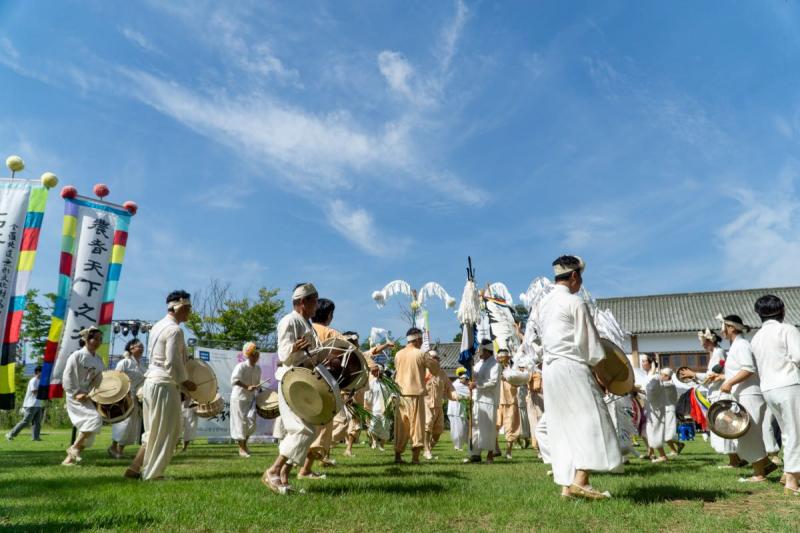
It wasn't a stage, but a 'pan.' People laughed and cried together at the singer's verse, exchanged greetings at the gut stage, and shared the hardships of life shoulder to shoulder at the Nongak performance. The performance was not about watching, but about coming together. Thus, the 'pan' of our ancestors that has continued for hundreds of years will reopen in Jeonju in the summer of 2026.
The 2026 Jeonju World Sound Festival (organized by Chairman Choi Cheol, hereinafter referred to as the Sound Festival) will be held for five days from August 12 to 16 at the Korean Sound Culture Hall and various locations in Jeollabuk-do. Celebrating its 25th anniversary this year, the Sound Festival focuses on the essence of our sound and the spirit of community that has been passed down through the ages, rather than elaborate stage settings or sensational spectacles. As the name of the festival suggests, while moving towards the world, it places its starting point at the most Korean roots of sound.
■ Gathering scattered sounds into one 'pan'
The theme of this year's Sound Festival is 'Breath of Sound, Gathered into a Pan,' symbolizing the gathering of scattered sounds, people, tradition, and the present into one pan. The opening and closing ceremonies unfold as symbolic stages that connect the beginning and end of the festival, seamlessly linking Pansori, Sanjo, Sinae, Gut, and Nongak, the original forms of Korean traditional arts. This festival goes beyond the audience merely watching the performances from their seats. It offers an experience where everyone breathes together with the performers, laughs and cries along with the sounds and rhythms, completing a unified 'pan.' It becomes a time to encounter the vitality and communal spirit of traditional arts in the most fundamental way.
■ The breath of master singers, connecting to the 17th century 350 years ago
At the heart of the festival is, of course, Pansori. The representative program of the Sound Festival, <Pansori Dasotbatang>, showcases the top master singers based in Jeonbuk, presenting their vocal and rhythmic skills in the closest proximity to the audience. Each verse resonating in the space where the boundaries between the audience and the stage are minimized vividly conveys the breath of the master singers and the tremors of the drumbeats, showcasing the essence of our sound. Following this, in <Young Pansori Dasotbatang>, the next generation of sound performers who add their own sensibilities on top of the traditional grammar take the stage. Their performances prove that Pansori is not just an art of the past but a living and breathing music of the present.
■ Tradition rejuvenates, sound meets the future
Not only Pansori but also the diverse depths of Korean traditional music unfold. In <Night of Sanjo>, masters Park Daesung and Park Beomhun present a stage that encapsulates spontaneity and artistry, while in <Today's Sinae>, emerging artists infused with new sensibilities based on tradition offer a glimpse into the future of Korean traditional music. Through this festival, the longstanding tradition meets young sensibilities, gaining new vitality, and the audience experiences a special time where the past, present, and future are interconnected.
■ Gut becomes a blessing, Nongak awakens the community
Gut and Nongak are the programs in this festival that vividly demonstrate the spirit of 'pan.' The Gangneung Danoje Preservation Society of UNESCO Intangible Cultural Heritage, <Gangneung Dano Gut>, conveys the energy of blessings and harmony, wishing everyone well, while Kim Sora's <Women's Nongak - Annyeong, Pyeongan Gut> reinterprets the vitality and communal spirit of female performers in a modern musical language. The <Mandure Pungjanggut> by the Gochang Nongak Preservation Society revives the vigor and vitality that blossomed in the toil of Kim Maegi's labor on stage. It is a time not just for a simple performance but for sharing and supporting each other, passing on the life and wisdom of our community to today's audience.
Kim Jung-soo, the executive director of the Sound Festival, emphasized, "To our ancestors, 'pan' was not just a performance space but a place of mutual sharing, adding joy to sorrow and receiving comfort in life through mutual communication." He stressed, "This festival focused on restoring the 'spirit of pan,' breaking down the boundaries between performers and the audience, and uniting everyone. Instead of flashy packaging, we will deliver the raw emotions and the vitality of solidarity inherent in Korean traditional arts."
Over the past 25 years, the Sound Festival has grown into a representative traditional arts festival that promotes the value of our sound domestically and internationally. And the twenty-fifth festival does not dwell on commemorating that time. It seeks the newest future from the oldest, reaffirms the roots of traditional arts, and declares a new beginning for another 25 years to come.
📝 Summary:
The 2026 Jeonju World Sound Festival will focus on traditional Korean arts and the spirit of community. It aims to bring together scattered sounds, people, traditions, and the present into one unified experience. The festival will feature various performances, including Pansori, Sanjo, Sinae, Gut, and Nongak, showcasing the essence of Korean sound and vitality of traditional arts.
🗣️ Natural Korean Translation:
2026년 전주 세계 소리 축제는 한국 전통 예술과 공동체 정신에 초점을 맞춥니다. 분산된 소리, 사람, 전통, 현재를 하나로 통합하는 것을 목표로 삼습니다. 이 축제는 판소리, 산조, 시내, 굿, 농악을 비롯한 다양한 공연을 선보이며 한국 소리의 본질과 전통 예술의 활력을 보여줍니다.
❓ Comprehension Questions:
1. What is the main focus of the 2026 Jeonju World Sound Festival?
해당 축제의 주요 초점은 무엇인가요?
2. How does the festival aim to connect the past, present, and future through performances?
축제는 어떻게 공연을 통해 과거, 현재, 미래를 연결하려고 합니까?
3. According to Kim Jung-soo, what is the significance of the 'pan' in traditional Korean arts?
김정수에 따르면 전통 한국 예술에서 '판'의 중요성은 무엇입니까?
💡 Vocabulary Learning:
1. essence / 본질 / noun
- The essence of a good cup of coffee lies in the quality of the beans.
- 좋은 커피 한 잔의 본질은 원두의 품질에 있다.
2. vitality / 활력 / noun
- Regular exercise is essential for maintaining vitality and overall health.
- 규칙적인 운동은 활력과 전반적인 건강 유지에 필수적이다.
3. communal / 공동체의 / adjective
- The communal garden was a place where neighbors came together to grow vegetables.
- 그 공동체 정원은 이웃들이 모여 채소를 키우는 곳이었다.
4. rejuvenates / 회복시키다 / verb
- A good night's sleep rejuvenates the body and mind.
- 좋은 밤 잠은 몸과 마음을 회복시킨다.
5. vitality / 활력 / noun
- Regular exercise is essential for maintaining vitality and overall health.
- 규칙적인 운동은 활력과 전반적인 건강 유지에 필수적이다.

💬 댓글 (0)
댓글을 작성하려면 로그인이 필요합니다.
로그인첫 댓글을 작성해보세요!