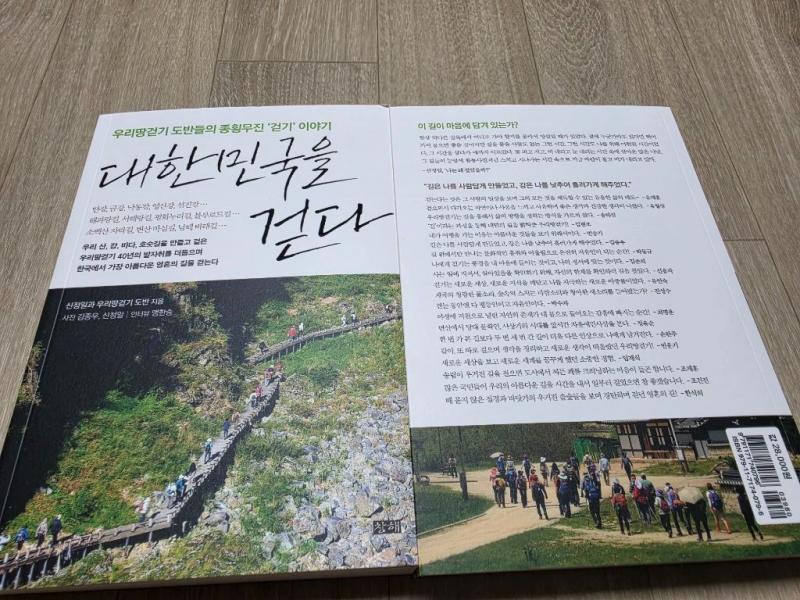
The book talk event for the new book "Walking through South Korea," which encapsulates the sacred journey of the first pedestrian travel group in South Korea, the nonprofit organization "Our Land Walking," over the past 40 years, was held on the 15th at the book cafe "Shinjeongil's Seoga" in Deokjin-gu, Jeonju, amid the enthusiastic support of members and readers.
The newly introduced book "Walking through South Korea" summarizes the historical journey of exploring the history, culture, and beauty of the Korean land that the organization has consistently embarked on for 40 years, starting from the winter of 1985 as the "Hwangtohyeon Cultural Research Institute" until changing its name to the nonprofit organization "Our Land Walking" in 2005.
The book, written by poet and writer Maeng Han-seung, directly interviewed the members of Our Land Walking and revisited the significant footsteps left by the organization, discussing the path forward. It has been praised as a "sincere self-portrait of Our Land Walking" for vividly capturing the living identity of the organization.
The event delved deeply into the unique achievements the organization has made over the past 40 years and the profound influence it has had on the pedestrian culture in South Korea. Our Land Walking planned and walked the first "Top 10 Rivers Exploration in Korea," walking from the source to the estuary of the Han River, Nakdong River, Geum River, Seomjin River, and Yeongsan River.
Furthermore, they walked historical old roads to restore them, such as the Yeongnam Road from Busan to Seoul, Samnam Road from Haenam to Seoul, and Gwandong Road connecting Heunginjimun in Seoul to Pyeonghae in Uljin, Gyeongsangbuk-do. Particularly, after walking along the East Sea coast from Busan to Gangwon's Goseong Unification Observatory and proposing it to the Ministry of Culture, Sports and Tourism, the "Haeparang Trail," which is now the most popular trail among the nation, was created. Based on this, the national integrated walking trail "Korea Dulegil" connecting the West Sea coast, South Sea coast, and the Armistice Line was completed.
Moreover, they took the lead in pioneering the Sobaeksan Mountain Trail, Byeonsan Masil Trail, and Jeonju Millennium High Road, and played a significant role in transitioning the Ministry of Education's school trip system into today's "on-site experiential learning" paradigm.
Our Land Walking's footsteps evolved into a movement beyond simple travel to erecting historical landmarks. They deeply reexamined movements like finding the old names of Jeonju and shedding light on the Donghak Peasant Revolution, leading to the construction of commemorative monuments for leaders of the Donghak Peasant Revolution, General Kim Gaenam and General Son Hwajung, in Deokjin Park in Jeonju.
They also contributed to reevaluating the distorted historical event of the Gicheok Oksa Incident and assisted in creating the Jeong Yeolip Park at the birthplace of Jeong Yeolip in Sanggwan-myeon, Wanju-gun, and designating a road in Jeonju Innovation City as "Jeong Yeolip Road."
Furthermore, they proved the historical value of old roads facing destruction, such as the Mungyeong Saejae, Galjae connecting Jeongeup and Jangseong, Nuritjae connecting Yeongnam and Gangjin, Yangpyeong Gujilhyeon, and Changnyeong Namjibyeorigil, by proposing them for designation as national scenic spots to the Cultural Heritage Administration, leaving a significant mark on the preservation of cultural heritage.
The memories of the brilliant cultural movements led by the organization were shared during the event, evoking deep reflections among the attendees.
Participants reminisced about various events such as "Conversations with Poets" held with Kim Yong-taek, An Do-hyun, Baek Hak-gi, Kim Jun-tae, and poet Jung Yang in 1986, the "Summer Poet Camp" held from 1986 to 1988 in Byeonsan and Seomjin River, the "Summer Cultural Square" that opened literary and academic discussions from 1989 to 2004, and the "Southern Journey" that deepened Korean geography and humanities. The activities of the Jeolla Traditional Customs Preservation Society (Yang Jin-sung) and the historical figures and intellectuals who breathed on the road were introduced like a lantern.
A member who participated in the book talk expressed, "It was truly a great fortune and blessing that for over forty years, many people could share the hidden historical truths and beauty of our land on this path from 1985 to 2026."
Shin Jeong-il, the chairman of Our Land Walking, stated, "The footsteps of Our Land Walking, which write history on the road and open the future through the path, are expected to provide deep resonance and new milestones to many in the future through the new book 'Walking through South Korea.'"
📝 Brief Summary:
The article discusses a book talk event for the new book "Walking through South Korea," which highlights the 40-year journey of the nonprofit organization "Our Land Walking." The book delves into the historical exploration of Korea's land, culture, and beauty, showcasing the significant achievements and influence of the organization on pedestrian culture in South Korea.
🗣️ Natural Korean Translation:
이 기사는 비영리 단체 "우리 땅 걷기"의 40년 여정을 강조하는 새 책 "한국을 걸어다니다"에 대한 북토크 이벤트를 다룹니다. 이 책은 한국의 땅, 문화 및 아름다움을 역사적으로 탐구하며, 이 단체의 중요한 성취와 한국의 보행 문화에 미친 영향을 보여줍니다.
❓ Comprehension Questions:
1. What was the focus of the book talk event mentioned in the article?
북토크 이벤트에서 어떤 내용이 주로 다뤄졌나요?
2. How has the nonprofit organization "Our Land Walking" impacted pedestrian culture in South Korea?
비영리 단체 "우리 땅 걷기"가 한국의 보행 문화에 어떤 영향을 미쳤나요?
3. What significant achievements of the organization are highlighted in the article?
기사에서 강조된 이 단체의 중요한 성취는 무엇인가요?
💡 Vocabulary Learning:
1. encapsulates / 요약하다 (verb)
- to encapsulate the main points of the discussion
- 토론의 주요 내용을 요약하다
2. embarked / 착수하다 (verb)
- The team embarked on a new project last month.
- 팀은 지난 달 새로운 프로젝트에 착수했습니다.
3. profound / 심오한 (adjective)
- Her speech had a profound impact on the audience.
- 그녀의 연설은 청중에게 심오한 영향을 미쳤다.
4. reevaluating / 재평가하는 (verb)
- They are reevaluating their marketing strategies.
- 그들은 자신들의 마케팅 전략을 재평가하고 있습니다.
5. preservation / 보존 (noun)
- The preservation of historical sites is crucial.
- 역사적인 장소의 보존이 중요합니다.

💬 댓글 (0)
댓글을 작성하려면 로그인이 필요합니다.
로그인첫 댓글을 작성해보세요!