It has been revealed that home care workers in the Jeonbuk region receive an average monthly wage of 1.58 million won even though they work more than 5 days a week. With the aging population and the expansion of community-based care systems, the demand for care work is rapidly increasing. However, issues such as short working hours, unstable employment, transportation costs, verbal abuse, and sexual harassment persist, indicating the need for more proactive improvement policies, including ensuring a living wage and compensating for travel time.
According to a recent statistical report on the labor conditions and policy implications of home care workers in Jeonbuk released by the Women and Family Foundation's Women's Policy Research Institute, the aging population and the demand for long-term care in Jeonbuk are increasing faster than the national average.
Compared to 2015, the proportion of people aged 65 and older in Jeonbuk is projected to increase by 8.7 percentage points by 2025, surpassing the national increase of 7.9 percentage points. By the end of 2025, the rate of long-term care utilization in Jeonbuk was also higher at 17.2% compared to the national average of 11.4%.
Along with the increasing demand for care, the number of care workers in facilities and home care in the Jeonbuk region has significantly increased. The number of care workers in the region rose from 13,048 in 2015 to 31,860 by the end of 2025, a 2.3-fold increase. However, there is also a disparity in service levels between urban areas like Jeonju, Iksan, and Gunsan, where long-term care facilities and staff are concentrated, and other areas.
The survey was conducted on 410 home care workers residing in Jeonbuk from September to October 2025.
The results showed that 94.4% of respondents worked more than 5 days a week, but their average weekly working hours were only 29.4 hours. 67.3% were classified as short-time workers, working less than 40 hours a week, and 31.5% had experience with overtime work. Among those who worked overtime, 28.7% reported not receiving additional overtime pay.
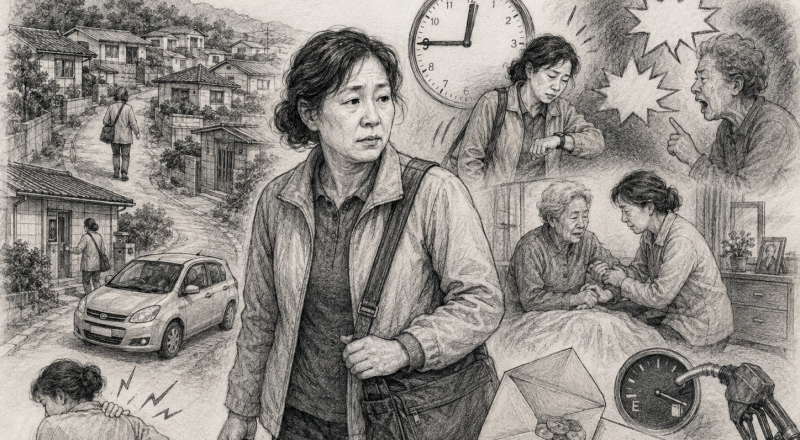
The nature of home care work also posed challenges due to travel requirements. 69.3% of respondents visited two or more households per day, with 76.8% using personal vehicles for transportation. However, 30.7% reported not receiving transportation support. Given the limited public transportation in rural areas, where reliance on personal vehicles is higher, there is a need to consider not only transportation costs but also the recognition of travel time as part of working hours and ensuring safety measures.
Instances of rights violations by users and families were not uncommon. 49.5% of respondents experienced misconduct during work, with disrespectful treatment at 20.7%, verbal abuse at 14.9%, sexual harassment or violence at 9.3%, and physical violence at 4.6%.
While 43.4% of respondents reported incidents of misconduct to their organizations and demanded action, 14.1% chose to endure it, and 4.6% quit their jobs. The main reason for enduring was the belief that complaining would not lead to improvements, highlighting the need for a response system that goes beyond mere reporting to ensure actual work stoppage and worker protection.
Health issues were also identified, with 21.5% reporting being sick or injured due to work, 9.3% having quit their jobs due to health reasons, and 26.3% having experienced presenteeism, where they went to work despite being ill. The foundation analyzed these issues as resulting from a lack of sick leave policies, absence of replacement staff, and concerns about service contract termination.
Employment itself was easily terminated based on the user's circumstances. 43.2% of respondents reported sudden termination of service contracts due to user hospitalization or facility admission. This often led to a de facto involuntary unemployment situation until they could secure a new user.
The average monthly wage was 1.58 million won, with 67.1% earning less than 2 million won per month. Only 44.1% received long-term service bonuses, and 8.0% received senior care worker bonuses. Despite the low wages compared to the demanding nature of the job, 73.7% of respondents expressed their intention to continue working as home care workers. This indicates a high level of vocational responsibility and commitment to care work, despite the inadequate wages and employment conditions.
The Long-Term Care Support Center operated by Jeonbuk Province also had lower actual usage rates compared to awareness levels. While 48.6% of respondents were aware of the center, only 4.9% had actual experience using it. With only four staff members covering 14 cities and counties in Jeonbuk, there are calls to increase regional accessibility. The most suggested improvement plan was the establishment of a comprehensive plan at 70.5%, followed by improving social awareness at 37.1% and enhancing practical skills at 21.7%.
As a policy proposal, the foundation suggested operating a pool of replacement staff, providing sick leave and health check-up support, protecting victims of sexual harassment and violence, establishing safety standards for mobile work, expanding tenure rewards, providing continuous psychological support, expanding the coverage of Long-Term Care Support Centers by region, and developing medium- to long-term improvement plans.
There are also calls in the local community for ensuring a living wage for care workers, which has been under discussion recently. This involves guaranteeing a substantial wage for disability support and home care workers above the level of the local government's living wage, gradually expanding the application of local government living wage ordinances to private outsourcing and social service areas. It also includes providing separate career bonuses for long-term workers, compensation for travel time between user homes, transportation expenses, additional pay for night and holiday work, and establishing sick leave and replacement staff systems.
However, as the systems and financial structures for home care workers and disability support workers differ, it is necessary to implement a method that does not simply integrate them under a single wage system but rather aligns with the realities of each system and includes local government support. It is crucial that the wage increase for care workers is not passed on to users or through reduced working hours, but that the national and local governments bear the additional financial burden. One possible approach is for the central government to actualize social service fees, while local governments cover the difference in living wages, career bonuses, transportation costs, and other expenses.
Ultimately, ensuring the sustainability of local community care systems cannot rely solely on increasing service supply. Establishing standards for "good care" that guarantee the rights of care recipients and provide adequate wages, employment stability, travel time compensation, rest, and health rights for care workers is a task that has been presented to Jeonbuk Province.
📝 Brief Summary:
The article discusses the challenges faced by home care workers in the Jeonbuk region, including low wages, short working hours, transportation issues, and mistreatment by users and families. Despite these difficulties, many workers express a commitment to their jobs. Suggestions for improvement include ensuring a living wage, providing sick leave, and enhancing safety measures.
🗣️ Natural Korean Translation:
전북 지역의 가정간병인들이 겪는 낮은 임금, 짧은 근무시간, 교통 문제, 그리고 이용자와 가족들로부터의 학대에 대해 논의하는 기사입니다. 이러한 어려움에도 불구하고 많은 노동자들이 자신의 직업에 헌신을 표현합니다. 개선 방안으로 생계 보장 임금, 유급 휴가 제공, 그리고 안전 조치 강화가 제안되었습니다.
❓ Comprehension Questions:
1. What are some of the challenges faced by home care workers in the Jeonbuk region?
가정간병인들이 전북 지역에서 직면하는 어려움은 무엇인가요?
2. What percentage of home care workers reported working more than 5 days a week but having average weekly working hours of only 29.4?
가정간병인 중 몇 퍼센트가 주당 평균 근무시간이 29.4시간인데도 주당 5일 이상 근무한 것을 보고했나요?
3. What are some of the proposed improvement plans for the situation of home care workers in the Jeonbuk region?
전북 지역의 가정간병인 상황을 개선하기 위한 일부 제안된 개선 계획은 무엇인가요?
💡 Vocabulary Learning:
1. wage / 임금 / noun
- The amount of money paid to an employee for work done.
- 직원이 한 일에 대해 받는 금액입니다.
- She received a higher wage after getting a promotion.
- 승진 후 그녀는 더 높은 임금을 받았다.
2. compensation / 보상 / noun
- Something, typically money, awarded to someone in recognition of loss, suffering, or injury.
- 손실, 고통 또는 부상을 인정받아 누군가에게 주어지는 것으로 보통 돈입니다.
- The company offered compensation for the damage caused by the mistake.
- 회사는 실수로 인한 피해에 대한 보상을 제공했다.
3. harassment / 괴롭힘 / noun
- Aggressive pressure or intimidation.
- 공격적인 압박 또는 위협입니다.
- She reported the case of harassment to the HR department.
- 그녀는 괴롭힘 사례를 인사 부서에 신고했다.
4. disparity / 불일치 / noun
- A great difference.
- 큰 차이입니다.
- There is a disparity in the quality of education between urban and rural areas.
- 도시와 시골 지역의 교육 품질에는 불일치가 있습니다.
5. sustainable / 지속 가능한 / adjective
- Able to be maintained at a certain rate or level.
- 특정 속도 또는 수준에서 유지될 수 있는 것입니다.
- The company implemented sustainable practices to reduce waste.
- 회사는 낭비를 줄이기 위해 지속 가능한 방법을 도입했다.

💬 댓글 (0)
댓글을 작성하려면 로그인이 필요합니다.
로그인첫 댓글을 작성해보세요!