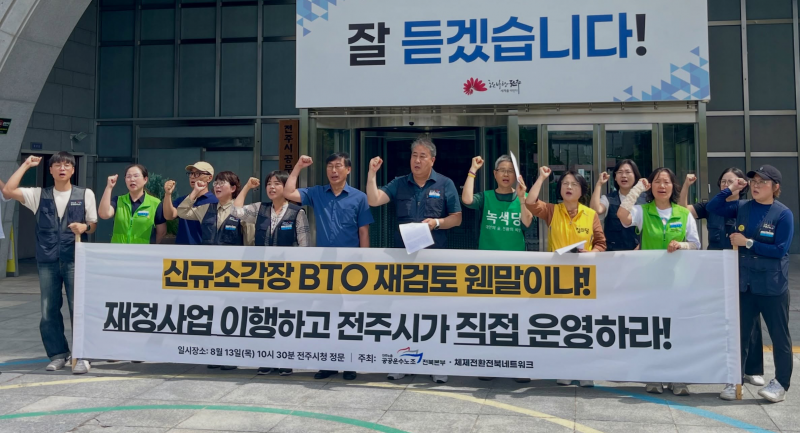
The Public Transport Workers' Union Jeonbuk Branch criticized the movement to reconsider the construction method of a new regional incineration plant in Jeonju by the Jeonju city government, urging to maintain the existing confirmed financial project method and operate it directly by the city.
On the 13th, the Public Transport Workers' Union Jeonbuk Branch stated, "Mayor Jo Ji-hoon is trying to revert the new incineration plant construction project to a Private Finance Initiative (PFI) method just a month after taking office," and argued, "The confirmed financial project method decided last year should be implemented without any wavering."
The new regional incineration plant is a facility to handle municipal waste from four cities and counties including Jeonju, Gimje, Wanju, and Imsil, with a total project cost of approximately 326 billion won.
The union emphasized that discussions on the funding method for the new incineration plant project have already been largely finalized.
The union stated, "Jeonju citizens have demanded that the new incineration plant should be pursued as a financial project, pointing out the issues with the Jeonju Recycling Town PFI project," and revealed, "Jeonju City confirmed the financial project through its own feasibility study, recognizing that it could reduce the burden on citizens by more than 200 billion won compared to the PFI method."
The union raised strong doubts about Mayor Jo Ji-hoon's recent announcement to reconsider the project method of the new incineration plant and to hold expert forums, saying, "The mayor emphasized the city's debt and financial crisis at a press conference 30 days after taking office, stating that over 100 facility investment projects would be thoroughly reviewed," and argued, "It is difficult to understand why a decision on a financial project that could save over 200 billion won is being shaken again under the pretext of a serious financial situation."
In particular, regarding the mayor's assertion of the efficiency of the private investment method, the union demanded transparency in revealing who approached and what proposals were made to the citizens.
The union expressed concerns that if the direction of a project worth billions of won that has already been confirmed changes according to the demands of specific stakeholders, it would be difficult to avoid suspicions of behind-the-scenes or favoritism, stating, "It is inevitable to suspect whether a proposal from a consortium of private investors that was previously rejected is being pushed again."
Regarding the issues with the private investment method, the union cited the case of the Jeonju Recycling Town, stating, "Jeonju citizens have already experienced the problems that can arise when essential environmental infrastructure is entrusted to private capital through the Recycling Town," and pointed out, "In the process of cost reduction and profit maximization, worker safety was neglected, leading to a gas explosion accident that resulted in five casualties."
Furthermore, they emphasized, "Conflicts and cost transfer issues surrounding improper waste disposal, wastewater intake issues, information non-disclosure citing trade secrets, and operational suspensions also followed," and stressed, "Environmental infrastructure should not be turned into a profit-making business for companies."
The union stated, "Once constructed, the incineration plant must responsibly manage the daily life and waste disposal administration of residents of the four cities and counties for decades as an essential public facility," and added, "The project method should not be influenced by short-term cost logic or proposals from private operators."
The union demanded that the Jeonju city government adhere to the existing financial project method and halt the reconsideration of the private investment method. They also advocated for the direct management and operation of the facility by the city after completion, rather than outsourcing to the private sector.
The Public Transport Workers' Union Jeonbuk Branch stated, "Rather than turning essential public facilities into means of profit pursuit once again, Jeonju City should take direct responsibility for the management and operation to ensure public and safety aspects of the new incineration plant," and declared, "We will strive to uphold the public nature of the new incineration plant to prevent a second Recycling Town tragedy."
Meanwhile, this statement focuses on the claims and issues raised by the Public Transport Workers' Union Jeonbuk Branch, and it is necessary to confirm the position of Jeonju City regarding the specific scope of the reconsideration of the new incineration plant project method and the possibility of re-launching the PFI method.
📝 Brief Summary:
The Public Transport Workers' Union Jeonbuk Branch criticized the Jeonju city government's plan to change the construction method of a new incineration plant, urging to stick with the existing financial project method and have the city operate it directly.
🗣️ Natural Korean Translation:
전북 지역의 교통 노동조합은 전주시 정부가 새로운 소각로 건설 방법을 재고하려는 움직임을 비판하며, 기존의 확정된 재정 사업 방법을 유지하고 도시가 직접 운영하도록 촉구했습니다.
❓ Comprehension Questions:
1. What is the main concern of the Public Transport Workers' Union Jeonbuk Branch regarding the new incineration plant project?
주요 걱정거리는 무엇인가요?
2. Why does the union criticize Mayor Jo Ji-hoon's plan to reconsider the construction method?
노동조합이 조지훈 시장의 건설 방법 재고 계획을 왜 비판하나요?
3. What are the potential consequences of changing the project method according to the union?
노동조합에 따르면 프로젝트 방법을 변경하는 것의 잠재적인 결과는 무엇인가요?
💡 Vocabulary Learning:
1. Incineration (소각), noun
- The process of burning waste or garbage.
- 쓰레기나 폐기물을 태우는 과정
- The city plans to build a new incineration plant to handle the increasing waste.
- 도시는 증가하는 쓰레기를 처리하기 위해 새로운 소각로를 건설하기로 계획했습니다.
2. Wavering (동요), verb
- To hesitate or be indecisive.
- 주저하거나 결정을 못 내리다
- The government should not waver in its commitment to environmental protection.
- 정부는 환경 보호에 대한 약속에서 동요해서는 안 됩니다.
3. Transparency (투명성), noun
- The quality of being open and honest.
- 공개되고 솔직한 품질
- The organization promised more transparency in its decision-making process.
- 조직은 의사 결정 과정에서 더 많은 투명성을 약속했습니다.
4. Stakeholders (이해관계자), noun
- People or groups who are affected by or can affect a decision or project.
- 결정이나 프로젝트에 영향을 받거나 영향을 줄 수 있는 사람이나 그룹
- It's important to involve all stakeholders in the decision-making process.
- 모든 이해관계자를 의사 결정 과정에 참여시키는 것이 중요합니다.
5. Favoritism (편애), noun
- The practice of giving unfair preferential treatment to one person or group over others.
- 다른 사람이나 그룹에 비해 한 사람이나 그룹에 불공평한 우대적 대우를 주는 행위
- The company's policies should be fair and avoid any hint of favoritism.
- 회사의 정책은 공정해야 하고 편애의 증거가 없어야 합니다.

💬 댓글 (0)
댓글을 작성하려면 로그인이 필요합니다.
로그인첫 댓글을 작성해보세요!