<Yoon Won-il's Mentee, Go Bo-yeon, Exhibits>
A small meeting that began in an artist's studio has turned into an exhibition after six years.
The art mentoring group "Chujin Mentoring," consisting of local visual artists and literary writers who have been meeting steadily with members of a developmental disability center for people with disabilities, will present a joint exhibition titled "I Am Your Mentor, You Are My Mentee" at the Seohak-dong Photo Art Museum in Jeonju from August 25 to 30.
This exhibition is not the result of simple art education or one-time talent donation. It is a "record of relationships" created by people who have been drawing together, sharing stories, and waiting for each other's time while moving back and forth between the artist's studio and various spaces in the region since 2021.
Chujin Mentoring started with the idea that the network of socially disadvantaged individuals should begin in an artist's studio. It has aimed for an equal relationship where artists and participants share their senses and stories, rather than a one-sided educational relationship where artists teach and lead people with developmental disabilities through art.
In this process, mentors have become not just simple teachers but "artistic companions," and mentees have grown from being recipients who need to learn from someone to expressing the world in their own senses and language as artists.
The exhibition features six visual artists and literary writers, including Go Na-young, Go Bo-yeon, Nam Min-i, Lee Mi-young, Chae Young-suk, and Hong Sung-mi. They have been engaging in artistic interactions for a long time with six mentees, including Jo In-wang, Yoon Won-il, Kwak Seung-hwan, Moon Jun-sik, Jo Mi-suk, and Lee Hye-jung.
Each relationship has its own unique color. Artist Kwak Seung-hwan fills the screen with mountains, clouds, rain, and houses in his own colors. He freely uses materials such as paint, crayons, markers, and colored pencils, boldly and straightforwardly unfolding his favorite blue and bright colors. In his works, one can feel the power of expressing the world he sees and feels in his own way rather than hesitating.
Artist Lee Hye-jung mainly draws landscapes with flowers, trees, and houses. She, who likes crayons, sometimes sulks, saying, "I can't do it," but completes her work with encouragement from her mentor. Her drawings are filled with unadorned purity and warm emotions.
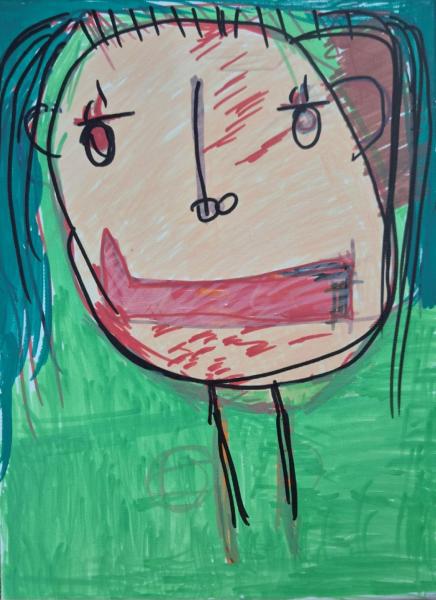
Artist Yoon Won-il's work is characterized by rough lines and bold coloring. Layering multiple colors and then structuring the screen again with black lines, he creates figures, houses, shapes, and grid patterns in his own visual language. His works, where gentle strokes and rough screens coexist, provide viewers with a unique visual tension.
Artist Moon Jun-sik finds scenes he wants to draw in photos on his mobile phone, gazes at them for a long time, and then slowly transfers them to the screen. His works, like his quiet and delicate nature, are relaxed and neat. Looking at the quiet scenes in his drawings gives viewers an experience of momentarily delaying their own time to gaze at them.
Artist Jo In-wang brightens the atmosphere of the group and also reveals his unique cheerfulness in his works. Recently, he enjoys drawing abstract screens inspired by natural landscapes. His works, where shapes and symbols freely float on the screen, have a lively feel, as if dancing or exchanging words.
Artist Jo Mi-suk is a person who observes the surroundings meticulously and empathizes with others' emotions. By expressing thoughts and observations freely on the screen, she has gradually shown changes in expressing objects and coloring during the mentoring process. In her works, one can discover the process of her world and inner stories gradually taking their place in the language of the drawings.
The mentors' works also enrich this exhibition.
Go Bo-yeon, who unfolds a feminist artistic language using discarded clothes and fabrics, has met various neighbors, including children, adolescents, people with disabilities, and the elderly, through cultural arts education and planning activities. Nam Min-i works on themes of inner recovery and emotional healing, practicing artistic communication through art education for children and people with disabilities.
Lee Mi-young explores the relationship between nature and humans, focusing on the "earth," expanding everyday landscapes encountered in life's time such as marriage and parenting into her works. Chae Young-suk has continued the relationship between people and art during long volunteer activities. Believing that "people are more beautiful than flowers," she draws flowers and shares deep communication with people with developmental disabilities through art.
Hong Sung-mi adds new stories to objects that are no longer useful, such as discarded wooden boards, masks, and used frying pans. Viewing humans and nature, endangered animals, and changing environments within one ecosystem, she continues her work of discovering "life from things being discarded and memories from things disappearing."
Go Na-young has been on a journey to find her own work through cultural arts education, planning, and design activities, and is currently exploring new possibilities of work in the experience of motherhood. Literary writer Kim Jun-jeong teaches math in a local small city and writes. While making a living by finding predetermined answers, he writes to find answers within himself. Following "Mom's Dress" and "Even Without Money," he published "At Some Point in Life, You Will Be Alone" in 2026.
In the meetings between artists who have lived different lives and members with developmental disabilities over the past six years, what is important is not "who taught whom." Rather, the six years were a process of learning from each other. Artists discovered new senses in the mentees' unadorned perspectives and expressions, while mentees broadened their experience of expressing their thoughts and emotions in the language of art through meetings with artists.
Therefore, the title of this exhibition, "I Am Your Mentor, You Are My Mentee," does not simply mean a distinction of roles. Instead, it signifies a relationship where, after a long time, they have become mentors and mentees to each other.
The societal view of disabilities often remains stuck in the frame of "people in need of help." However, their work transcends this frame. Before being people who receive help, they are creators with their own senses, tastes, memories, and imaginations, communicating with the world through their works as artists.
This exhibition quietly but clearly shows this fact.
Art can not only change someone but also make them see each other's existence and build relationships. And respecting one's life is not a grand institution or slogan but can start from small meetings where people draw together, share stories, and keep each other's company.
This exhibition, where a six-year-long meeting unfolds in one space, makes us rethink the social solidarity and independence through art, as well as the potential of local communities.
"I Am Your Mentor, You Are My Mentee" will be held at the Seohak-dong Photo Art Museum from August 25 to 30. A meeting with the artists is scheduled for August 27 at 2:30 p.m.
📝 Summary:
A mentoring group called "Chujin Mentoring" consisting of local artists and writers has been meeting with individuals from a developmental disability center for six years. They will hold an exhibition titled "I Am Your Mentor, You Are My Mentee" at a museum in Jeonju. The exhibition showcases the unique artistic expressions of both mentors and mentees, emphasizing the equal relationship they have developed over time.
🗣️ Korean Translation:
한 예술가와 작가로 구성된 멘토링 그룹인 "추진 멘토링"은 발달 장애 센터의 사람들과 6년 동안 만나왔습니다. 그들은 전주의 박물관에서 "나는 너의 멘토, 너는 내 멘티"라는 제목의 전시회를 개최할 예정입니다. 이 전시회는 멘토와 멘티 사이에 발전한 평등한 관계를 강조하며 그들의 독특한 예술적 표현을 전시합니다.
❓ Comprehension Questions:
1. What is the title of the exhibition that will be held at the Seohak-dong Photo Art Museum?
전시회의 제목은 무엇입니까?
2. How long have the artists and members with developmental disabilities been meeting together?
예술가들과 발달 장애를 가진 회원들이 함께 만나온 기간은 얼마나 되나요?
3. What is the significance of the relationship between mentors and mentees according to the article?
기사에 따르면 멘토와 멘티 사이의 관계의 의미는 무엇인가요?
💡 Vocabulary Learning:
1. exhibition, 전시, noun
- A public display of works of art or items of interest, held in an art gallery or museum.
- 미술관이나 박물관에서 열리는 작품이나 흥미로운 항목의 공개 전시
- The new exhibition at the museum features contemporary art pieces.
- 박물관에서의 새로운 전시는 현대 예술 작품들을 소개합니다.
2. mentoring, 멘토링, noun
- The act of providing guidance, advice, and support to someone with less experience in a particular area.
- 특정 분야에서 경험이 적은 사람에게 지도, 조언 및 지원을 제공하는 행위
- She received mentoring from a senior colleague to improve her skills.
- 그녀는 기술을 향상시키기 위해 선임 동료로부터 멘토링을 받았습니다.
3. expression, 표현, noun
- The process of making known one's thoughts or feelings through words, actions, or artistic creations.
- 단어, 행동 또는 예술적 창작을 통해 자신의 생각이나 감정을 알리는 과정
- His paintings are a powerful expression of his inner struggles.
- 그의 그림은 그의 내적 갈등의 강력한 표현입니다.
4. unadorned, 장식되지 않은, adjective
- Plain or simple, without any additional decoration or embellishment.
- 어떤 추가 장식이나 장식 없이 평범하거나 간단한
- The unadorned beauty of the traditional pottery impressed the visitors.
- 전통 도자기의 장식되지 않은 아름다움이 방문객들을 감동시켰다.
5. interaction, 상호 작용, noun
- Communication or direct involvement with someone or something.
- 누군가나 무언가와의 직접적인 소통 또는 관련
- The interaction between the characters in the movie was captivating.
- 영화 속 캐릭터들 간의 상호 작용이 매혹적이었습니다.

💬 댓글 (0)
댓글을 작성하려면 로그인이 필요합니다.
로그인첫 댓글을 작성해보세요!