
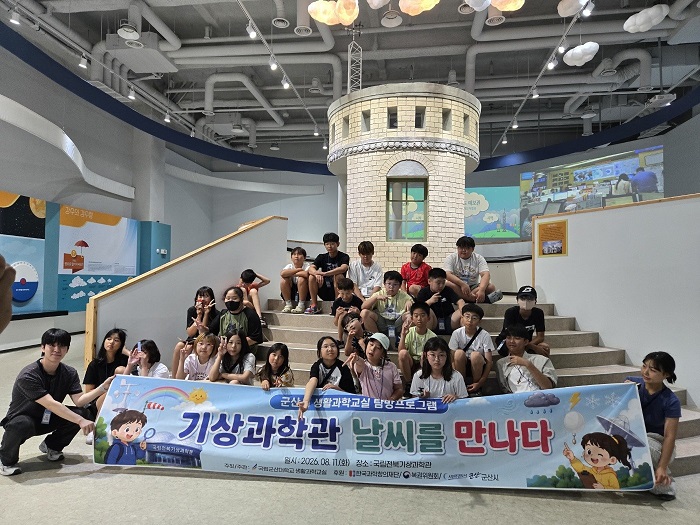
【전북교육신문】국립군산대학교 생활과학교실은 지난 11일과 20일 군산시와 부안군 초등학생을 대상으로 국립전북기상과학관 탐방 프로그램을 진행했다.
이번 프로그램은 학생들이 기상과 천문 분야의 과학 원리를 직접 체험하며 과학에 대한 흥미와 탐구심을 높일 수 있도록 체험 중심으로 운영됐다.
학생들은 ‘기상 천문 탐구교실’에 참여해 날씨와 기상 현상, 천문 원리를 배우고 태양 관측 등 교실에서는 경험하기 어려운 체험 활동에 참여했다.
또 다양한 전시 콘텐츠를 통해 기상과학에 대한 이해를 넓히고, 조별 퀴즈게임을 통해 배운 내용을 확인하며 협동심을 키웠다.
한 참가 학생은 “기상 현상을 직접 체험해 보니 과학이 더 재미있게 느껴졌다”며 “친구들과 퀴즈를 풀며 배운 내용을 다시 확인할 수 있어 즐거웠다”고 말했다.
유수창 국립군산대 생활과학교실 센터장은 “이번 탐방이 학생들이 기상과 천문에 대한 호기심을 키우는 계기가 됐기를 바란다”며 “앞으로도 지역 학생들이 다양한 과학문화를 경험할 수 있는 체험형 프로그램을 지속적으로 운영하겠다”고 밝혔다.
이번 프로그램은 과학기술진흥기금과 복권기금의 재원으로 운영되며, 과학기술정보통신부와 한국과학창의재단의 지원을 받아 추진됐다.
National Gunsan University's Home Economics Laboratory to Operate Weather and Astronomy Experience Program for Elementary School Students
The Department of Life Science at the National Gunsan University conducted a visit program to the National Jeonbuk Meteorological Science Museum for elementary school students in Gunsan and Buan on the 11th and 20th of last month.
This program was designed to enhance students' interest and curiosity in science by allowing them to directly experience the scientific principles in the fields of meteorology and astronomy.
The students participated in the "Meteorology and Astronomy Exploration Classroom" where they learned about weather phenomena, meteorological principles, astronomical principles, and engaged in hands-on activities such as observing the sun, which are difficult to experience in a regular classroom setting.
They also broadened their understanding of meteorological science through various exhibition contents, confirmed their learning through group quiz games, and developed teamwork skills.
One participating student said, "Experiencing weather phenomena firsthand made science more enjoyable for me," and added, "It was fun to solve quizzes with friends and review what we learned."
Yoo Soo-chang, the director of the Department of Life Science at the National Gunsan University, expressed hope that this visit would spark students' curiosity about meteorology and astronomy, stating, "We will continue to operate experiential programs that allow local students to experience various scientific cultures."
This program was funded by the Science and Technology Promotion Fund and the Lottery Fund, and was supported by the Ministry of Science and ICT and the Korea Foundation for the Advancement of Science & Creativity.
📝 Summary:
The Department of Life Science at National Gunsan University organized a visit program to the National Jeonbuk Meteorological Science Museum for elementary school students in Gunsan and Buan. The program aimed to increase students' interest in science by providing hands-on experiences related to meteorology and astronomy.
🗣️ Natural Korean Translation:
국립 군산대학교 생명과학부는 지난 달 11일과 20일에 군산과 부안의 초등학생들을 위해 전북 기상과학박물관 방문 프로그램을 진행했습니다. 이 프로그램은 기상학과 천문학 분야에서 과학 원리를 직접 체험하도록 허용함으로써 학생들의 과학에 대한 흥미와 호기심을 증가시키기 위해 설계되었습니다.
❓ Comprehension Questions:
1. What was the purpose of the visit program organized by the Department of Life Science at National Gunsan University?
그 국립 군산대학교 생명과학부가 진행한 방문 프로그램의 목적은 무엇이었습니까?
2. What did the students learn in the "Meteorology and Astronomy Exploration Classroom"?
학생들은 "기상학과 천문학 탐험 교실"에서 무엇을 배웠습니까?
3. Who expressed hope that the visit would spark students' curiosity about meteorology and astronomy?
누가 그 방문이 학생들의 기상학과 천문학에 대한 호기심을 일으킬 것이라고 희망을 표현했습니까?
💡 Vocabulary Learning:
1. meteorology (기상학, noun)
- The study of the earth's atmosphere and weather conditions.
- 대기와 날씨 조건에 대한 연구.
- Meteorology is an interesting subject to study.
- 기상학은 공부하기 흥미로운 주제입니다.
2. astronomy (천문학, noun)
- The scientific study of stars, planets, and other objects in outer space.
- 별, 행성 및 외부 공간의 다른 물체에 대한 과학적 연구.
- She is fascinated by astronomy and often gazes at the stars at night.
- 그녀는 천문학에 매료되어 밤에 별들을 자주 바라봅니다.
3. principles (원리, noun)
- Fundamental truths or rules that explain how something works.
- 어떤 것이 어떻게 작동하는지 설명하는 기본적인 진리나 규칙.
- The teacher explained the principles of physics in a simple way.
- 선생님은 물리학의 원리를 간단하게 설명했습니다.
4. phenomena (현상, noun)
- Observable events or occurrences that can be studied.
- 연구할 수 있는 관측 가능한 사건이나 발생.
- The scientist conducted experiments to understand natural phenomena better.
- 그 과학자는 자연 현상을 더 잘 이해하기 위해 실험을 진행했습니다.
5. curiosity (호기심, noun)
- A strong desire to know or learn something new.
- 새로운 것을 알고 배우려는 강한 욕망.
- Children often show curiosity about the world around them.
- 어린이들은 주변 세계에 대해 호기심을 자주 보입니다.
💬 댓글 (0)
댓글을 작성하려면 로그인이 필요합니다.
로그인첫 댓글을 작성해보세요!