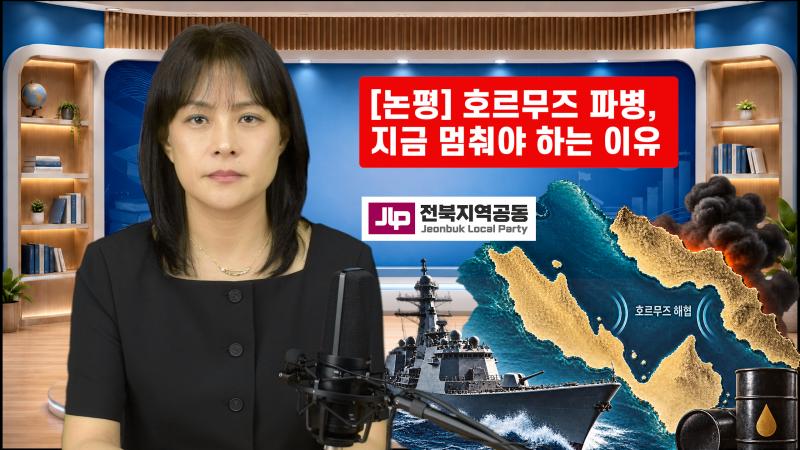
A group in the Jeonbuk region has urged the government to halt the consideration of dispatching troops to the Strait of Hormuz, stating that the issue is not about combat or non-combat roles, but rather the problem lies in sending our military to support military operations in regions where wars are taking place.
The Jeonbuk region group released a statement on the 7th, saying, "What the government should do now is not to participate militarily in wars but to raise its voice for diplomatic solutions," and emphasized that the consideration of dispatching troops should be stopped.
The Blue House responded on the 3rd, denying some reports that the government was leaning towards dispatching troops to the Strait of Hormuz, stating that "it is not true" and that "no decision has been made on the matter." However, on the following day, the Blue House explained that various options such as combat, non-combat, and reconnaissance missions are being comprehensively reviewed to contribute to the 'substantial contribution' for the free passage in the Strait of Hormuz.
Currently, military contribution options being mentioned include the Navy's P-8A maritime patrol aircraft, a destroyer for logistical support, and Explosive Ordnance Disposal (EOD) forces. However, the government maintains its position that the specific scale or method of dispatch has not been decided.
The Jeonbuk region group pointed out, "Despite the government's explanation that nothing has been decided, discussions are gradually becoming more specific, including the mention of deployable forces and missions."
They further argued that the ongoing Middle East war, which started with Israel's attack on Iran and expanded with U.S. involvement, could result in supporting the military operations of the warring parties regardless of whether it is a combat or non-combat mission if our military participates.
President Donald Trump of the United States demanded in March that countries including South Korea, China, Japan, the UK, and France send warships to the Strait of Hormuz to participate in ship escorts and other activities.
The group stated, "The background of the troop dispatch discussion cannot be simply viewed as an energy security issue," and claimed that it seems to be considering diplomatic and trade relations, including the South Korea-U.S. alliance and U.S.-China relations.
They also raised the issue of consistency between President Lee Jae-myung's past remarks regarding Israel and the current consideration of troop dispatch.
President Lee shared a video on social media in April, comparing civilian casualties and Jewish massacres during Israel's military operation in Gaza to emphasize human dignity. When the Israeli Foreign Ministry criticized this, President Lee responded through social media, suggesting the need for international scrutiny of anti-human rights and anti-international law actions.
The Jeonbuk region group criticized, "If a government that previously criticized aggressive wars and anti-human rights actions now considers ways to cooperate militarily in such wars, there is a conflict between words and actions."
To deploy the military overseas, approval from the National Assembly is required. Article 60, paragraph 2 of the Constitution grants the National Assembly the authority to approve the foreign deployment of the military.
Public opinion has also shown a negative sentiment towards troop dispatch. In a survey conducted by Gallup Korea from March 17 to 19, among 1,400 adults aged 18 and older nationwide, 55% responded that "our warships should not be dispatched to the Strait of Hormuz," while 30% responded that "they should be dispatched."
The Jeonbuk region group emphasized, "Energy security, protection of maritime traffic routes, and economic interests cannot be sufficient justifications for troop dispatch to war zones," and stressed that it is the duty of the military personnel, not policymakers, to directly handle risks.
They expressed concerns that if we rely on the logic of justifying preemptive military actions for security needs or possibilities, our grounds for opposing similar logic on the Korean Peninsula in the future may weaken.
They concluded by stating, "South Korea's role should not be to send troops to wars but to prevent the spread of wars and urge diplomatic solutions," and urged the government to halt the consideration of dispatching troops to the Strait of Hormuz and engage in diplomatic efforts for peaceful resolutions.
📝 Brief Summary:
A group in the Jeonbuk region is against South Korea sending troops to the Strait of Hormuz during ongoing wars in the area. They believe the focus should be on diplomatic solutions instead of military involvement. The group criticizes the government for considering various military options, including combat and non-combat roles, and emphasizes the need to prioritize peaceful resolutions.
🗣️ Natural Korean Translation:
전북 지역의 한 그룹은 한국이 호르무즈 해협에 군대를 파견하는 것에 반대하고 있습니다. 그들은 군사 개입 대신 외교적 해결책에 중점을 두어야 한다고 믿습니다. 그들은 정부가 전투 및 비전투 역할을 포함한 다양한 군사 옵션을 고려하고 있다는 점을 비판하며 평화로운 해결책을 우선시해야 한다고 강조합니다.
❓ Comprehension Questions:
1. What is the main concern of the group in the Jeonbuk region regarding the dispatch of troops to the Strait of Hormuz?
해협에 군대를 파견하는 것에 대한 전북 지역 그룹의 주요 우려는 무엇입니까?
2. How does the Blue House respond to reports about the consideration of dispatching troops to the Strait of Hormuz?
청와대는 해협에 군대를 파견하는 것을 고려한 보도에 대해 어떻게 대응합니까?
3. What is the group's opinion on the justification for sending troops to war zones based on security needs?
안보 필요성을 근거로 전쟁 지역으로 군대를 파견하는 것을 정당화하는 데 대해 그룹은 어떻게 생각합니까?
💡 Vocabulary Learning:
1. dispatch (파견하다, 동사)
- to send someone or something to a particular place for a particular purpose
- 특정 장소로 특정 목적을 위해 누군가나 무언가를 보내다
- The company dispatched a team of experts to investigate the issue.
- 회사는 문제를 조사하기 위해 전문가 팀을 파견했습니다.
2. reconnaissance (정찰, 명사)
- the act of getting information about enemy forces or the position of an army
- 적군의 정보나 군대의 위치에 대한 정보를 입수하는 행위
- The reconnaissance mission provided valuable data for the military operation.
- 정찰 작전은 군사 작전을 위한 가치 있는 데이터를 제공했습니다.
3. substantial (상당한, 형용사)
- large in amount, value, or importance
- 양, 가치 또는 중요성이 큰
- The company made a substantial investment in research and development.
- 그 회사는 연구 개발에 상당한 투자를 했습니다.
4. consistency (일관성, 명사)
- the quality of always behaving or performing in a similar way
- 항상 비슷한 방식으로 행동하거나 수행하는 품질
- There should be consistency in the application of company policies.
- 회사 정책의 적용에는 일관성이 있어야 합니다.
5. preemptive (선제적인, 형용사)
- done as a measure to prevent something unpleasant or dangerous from happening
- 불쾌하거나 위험한 일이 일어나는 것을 막기 위한 조치로 이루어진
- The country took preemptive action to avoid a potential crisis.
- 그 나라는 잠재적인 위기를 피하기 위해 선제적 조치를 취했습니다.

💬 댓글 (0)
댓글을 작성하려면 로그인이 필요합니다.
로그인첫 댓글을 작성해보세요!