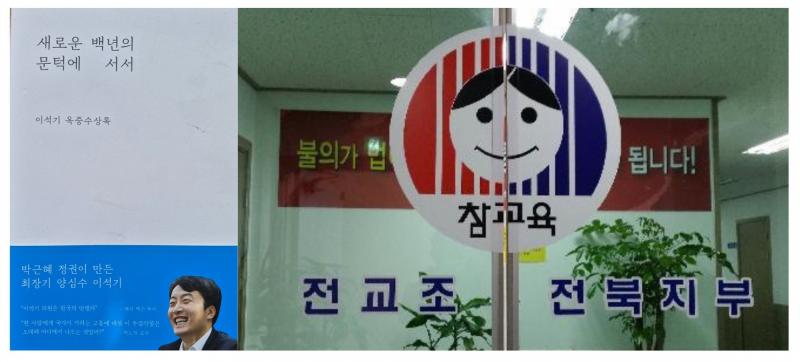
The Jeonbuk branch of the National Teachers Union is questioning the purchase of 40 books authored by Lee Seok-gi, a former member of the Unified Progressive Party, in 2021, as educational material. Subsequently, the head of the Jeonbuk branch of the union encouraged participation in signing for Lee Seok-gi's pardon and amnesty, referring to former President Park Geun-hye as the 'perpetrator' and Lee Seok-gi as the 'victim'.
The purchase of 40 books, encouragement of signing for pardon and amnesty, and the designation of Lee Seok-gi as a 'victim' are not easily seen as separate incidents. This can be interpreted as an attempt to view Lee Seok-gi as a political victim oppressed by state power.
However, it is difficult to agree with simply designating Lee Seok-gi as a symbol of progressivism or a conscientious objector without any explanation. He is a person who has been convicted by the Supreme Court for discussing and inciting violent acts in the context of war and has been found guilty. His actions cannot simply be covered by the phrase 'victim of the National Security Law'.
In 2015, the Supreme Court confirmed Lee Seok-gi's guilt for incitement to rebellion. At that time, the court determined that his speech urging concrete acts of destruction of national infrastructure, such as the outbreak of war, could induce or escalate rebellion among the attendees.
The key point is not just about the charges. One must consider the direction of violence implied by the speech at that time. Discussing the destruction and paralysis of national infrastructure like railways, telecommunications, and power supply in the context of war is not a form of anti-war activism. Anti-war activism should start with discussions on how to prevent war. When discussions shift to what to destroy and who will carry out those actions in the event of war, the language of peace transforms into the language of war.
National infrastructure is not just a symbolic representation of abstract state power. If power is cut off, life-saving equipment in hospitals can stop functioning. Disruption in communication can isolate citizens during disasters and wartime situations. If railways and energy supply are disrupted, the daily lives of ordinary citizens, such as workers, small business owners, patients, and children, will be the first to be affected.
And who are the people on the front lines protecting these facilities? They are not politicians or leaders of movements. They are ordinary young people conscripted into military service. Furthermore, these young individuals are not anonymous soldiers who suddenly appear one day. They are the students taught by teachers in schools, the same students studying in classrooms now, who may face such realities in a few years.
When war breaks out, a significant number of those tasked with protecting national infrastructure, such as power plants, railways, and communication facilities, are these young individuals. Discussing acts that would destroy or paralyze national infrastructure ultimately presupposes a scenario where there is a conflict with the young people deployed to protect these facilities.
The idea of presenting facility destruction as an act of execution cannot be separated from the issue of pushing students taught by teachers into situations where they may kill or be killed. Therefore, teacher organizations should take a more serious look at this issue.
For teachers who teach peace and human rights, the young people wearing military uniforms are also their students. Opposing war means not just sticking to abstract slogans but ensuring that the students they have taught do not end up on the battlefield and preventing situations where they point guns at each other.
If one claims to be progressive, they must stand by the youth. Before questioning where the gun is from, one must first see who is standing in front of that gun. Ignoring North Korea's military threats while only criticizing US military actions, or applying different standards to violence that can endanger domestic youth and citizens while opposing wars waged by the US, makes it difficult to call it consistent pacifism.
The National Security Law should be abolished. The authority of the state to punish thought and expression should be severely restricted in a democratic society. Criticism that the National Security Law has been used as a means to suppress political opponents and minority opinions for a long time is valid. However, advocating for the abolition of the National Security Law and evaluating all actions of former lawmaker Lee Seok-gi as progressive are entirely different issues. When a person convicted of incitement to rebellion by the Supreme Court is referred to as a 'conscientious objector' without any explanation, that expression can become more of a specific political language than a universal language of conscience.
Of course, one can criticize the legitimacy of applying the National Security Law. It is possible to debate whether the scope and penalties for incitement to rebellion were appropriate. However, the fact of the violence incitement recognized by the court does not disappear. There is not enough justification to evaluate Lee Seok-gi's actions at that time as progressive or to designate him as a conscientious objector without further explanation.
The purchase of 40 books by the Jeonbuk branch of the National Teachers Union is different from a simple personal reading preference. If a significant number of books were purchased as educational material for the organization, an explanation and verification are needed regarding what political message the selection intended to convey to its members. Encouraging signing for pardon and amnesty by the head of the branch at that time and referring to Lee Seok-gi as a 'victim' make the direction even clearer. The issue is not the fact that a pardon was requested. Anyone has the freedom to request pardon and amnesty.
The crux lies in what premise underlies that claim. The moment Lee Seok-gi is solely designated as a victim sacrificed under the unilateral oppression of the Park Geun-hye government, the political and ethical evaluation of his speeches urging acts of destruction of national infrastructure in the context of war disappears.
Teachers are individuals who educate the future citizens. The National Teachers Union has long upheld labor rights, human rights, peace, and democracy as important values. Therefore, stricter standards are necessary. Especially when young people in South Korea wearing military uniforms may have to protect national infrastructure in the event of war, they are the students teachers are currently teaching in classrooms or those who have already graduated. If teachers speak of peace, the first people they should think of are these students.
How will teachers view the situation where their students, whom they have taught, one day wear military uniforms and protect power plants, railways, and communication facilities, facing acts of destruction by someone else? The standards of progressivism and peace must be verified in front of the concrete lives of these individuals.
Under the name of progressivism, one should not turn a blind eye to one side's military threats while only criticizing the military actions of the opposing faction. Abolishing the National Security Law does not justify incitement to violence. The term peace should not be used to heroize individuals who incite violent acts in wartime situations without any criticism.
Lee Seok-gi is not a progressive. He is not a conscientious objector. Individuals who discuss and incite violent acts that can endanger the lives of South Korean soldiers and civilians in the face of the risk of war should be criticized. Especially, if those young people wearing military uniforms are the students taught by teachers, teacher organizations should take this fact more seriously.
The standard of progressivism lies not in being friendly to North Korea or critical of the US but in protecting democracy, human rights, peace, and the lives of citizens regardless of the faction they belong to. Among those citizens are the students taught by teachers. Once this standard is lost, progressivism can no longer be truly progressive.
📝 Brief Summary:
The Jeonbuk branch of the National Teachers Union purchased 40 books by Lee Seok-gi, a former member of a progressive party, as educational material. They also encouraged signing for Lee Seok-gi's pardon and referred to him as a victim. This raised questions about viewing Lee Seok-gi as a political victim oppressed by state power due to his past actions.
🗣️ Natural Korean Translation:
국립교사연합 전북지부는 2021년에 전진당 전직원인 이석기가 저술한 40권의 책을 교육 자료로 구매한 것에 대해 의문을 제기했습니다. 이에 따라, 연맹 전북지부장은 이석기의 사면과 사면에 서명하도록 권장하며, 전 대통령 박근혜를 '가해자'로, 이석기를 '피해자'로 지칭했습니다.
❓ Comprehension Questions:
1. What sparked questions from the National Teachers Union in Jeonbuk regarding the purchase of Lee Seok-gi's books?
국립교사연합 전북지부를 향해 이석기의 책 구매에 대한 의문을 제기한 것은 무엇입니까?
2. How did the head of the Jeonbuk branch of the union encourage participation regarding Lee Seok-gi's situation?
연맹 전북지부장은 어떻게 이석기의 상황에 대한 참여를 촉구했습니까?
3. Why is it mentioned that Lee Seok-gi's actions cannot be simply covered by the phrase 'victim of the National Security Law'?
이석기의 행동이 '국가보안법의 피해자'라는 표현만으로 간단히 설명되지 않아야 하는 이유는 무엇입니까?
💡 Vocabulary Learning:
1. purchase / 구매 (noun)
- Buying something for a price.
- 무언가를 가격에 살 때
- I made a purchase of some new books yesterday.
- 어제 새 책을 구매했어요.
2. incitement / 선동 (noun)
- Encouraging or persuading someone to do something illegal or violent.
- 누군가에게 불법적이거나 폭력적인 행동을 하도록 격려하거나 설득하는 것
- His speech was seen as incitement to violence.
- 그의 연설은 폭력 선동으로 여겨졌다.
3. oppression / 억압 (noun)
- Prolonged cruel or unjust treatment or control.
- 장기간에 걸쳐 잔인하거나 불공평한 대우나 통제
- The people suffered under the oppression of the dictator.
- 그 사람들은 독재자의 억압 아래 고통을 겪었다.
4. symbolic / 상징적인 (adjective)
- Serving as a symbol.
- 상징으로 작용하는
- The dove is a symbolic representation of peace.
- 비둘기는 평화의 상징적 표현이다.
5. conscientious / 양심적인 (adjective)
- Wishing to do what is right, especially to do one's work or duty well and thoroughly.
- 올바른 일을 하고자 하는, 특히 자신의 일이나 의무를 잘하고 철저히 하는
- She is a conscientious student who always completes her assignments on time.
- 그녀는 항상 숙제를 제시간에 완료하는 양심적인 학생이다.

💬 댓글 (0)
댓글을 작성하려면 로그인이 필요합니다.
로그인첫 댓글을 작성해보세요!