<b>National Association of Top Secondary School Teachers President Kwon Hyuk Sun</b>
<b>Why High School Credit System is Absolutely Necessary for Preventing Underachievers and Responsible Education</b>
The biggest issue in the education field recently is "academic decline." This term goes beyond simply having low grades and carries concerns about the trust and functionality of public education being shaken. In particular, academic decline in mathematics is closely linked to the increase in "underachievers" (students who give up on math). The presence of many underachievers indicates that there are many students who cannot keep up with math classes, signaling a serious academic gap within the classroom.
According to the 2024 national academic achievement assessment results, the percentage of high school seniors lacking basic academic skills has increased in both Korean (8.6%) and math (16.6%). The situation is particularly severe in math. Various methods have been suggested to reduce this phenomenon, but there have not been clear results yet. So, what is the real solution needed?
The answer lies in the "organization of the curriculum." Depending on how and what subjects are taught, students' academic achievements can vary significantly.
Why is the math achievement in Jeonbuk low?
#Photo: d6acc95c1ad8b3acf6deb931afa7688b_58TZVWsz_ada23fdc515aa285aabc406767ae24dafc011d79.jpg
According to data released by Jongno Academy, the percentage of high school students in Jeonbuk achieving an A grade in math is only 7.7%, the lowest in the country. It is only half the national average of 16.5%. The reasons for such low achievement can be broadly analyzed in two ways.
One is the operation of the education system that obliges students to take all subjects with a high hierarchical status. The other is that this operational method, aligned with relative evaluation for college entrance and a test-oriented curriculum, imposes excessive burdens on students.
Case of School A: Rapid Pace, Many Underachievers
#Photo: d6acc95c1ad8b3acf6deb931afa7688b_jo9szmTi_430355b7140a0dfde0e43d493590cab120a59268.jpg
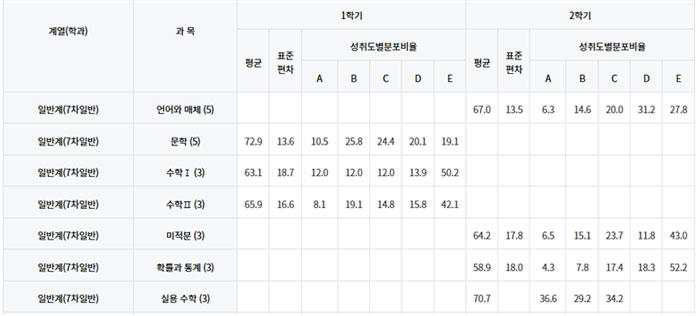
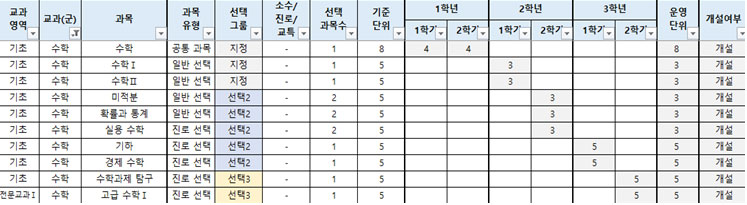
School A made both Math I and Math II mandatory, progressing quickly at a rate of 3 units per semester instead of the original 5 units. By reducing the subject from 5 units to 3 units, the pace was fast, and only some students who had prior learning led the class. The rest of the students either could not keep up with the class, becoming underachievers, or relied on private education.
Math I average: 65 points
A level (90 points or above): 12.0%
E level (60 points or below): 50.2%
Math II average: 64 points
A level: 8.1%
E level: 42.1%
The grades for probability and statistics in the second semester are even more severe. The average is 58.9 points, with A level at 4.3% and E level at 52.2%, meaning more than half lack basic skills.
This high academic gap occurred because students were forced to take high-status subjects even if their math skills were low, limiting their subject choices.
Internal Competition? Credit System and Absolute Evaluation as Solutions
#Photo: d6acc95c1ad8b3acf6deb931afa7688b_FIXg8Ddl_6798c144a1a68482ac561baa136f0dac90f7f557.jpg
Regarding this curriculum organization, teachers in the field express concerns that "if the number of students decreases, internal competition for college entrance could intensify." Therefore, math is designated as a compulsory subject, and all students are required to take the same subjects without choice. However, this method is a major cause of mass production of underachievers.
To solve this, a high school credit system focused on absolute evaluation and achievement assessment is necessary. The credit system ensures subject selection tailored to students' academic levels and career paths, allowing them to learn at their own pace without giving up on classes.
Case of School B: Ensuring Choice, Improving Achievement
#Photo: d6acc95c1ad8b3acf6deb931afa7688b_tAwx3pj1_6b6c0bda643d9b79c8e385547f1ae4df5440699d.jpg
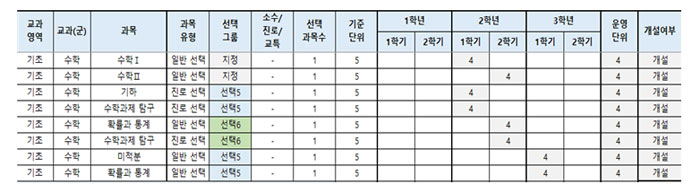
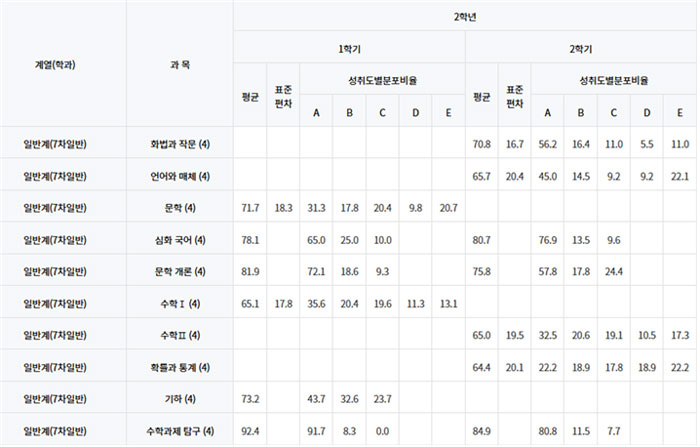
School B scheduled only Math I in the first semester of the second year, with Math II in the second semester and probability and statistics in the third year. They also operated flexibly, allowing multiple selections for math projects and probability and statistics.
Math I average: 65.1 points
A level: 35.6%
E level: 13.1%
Math II average: 65.0 points
A level: 32.5%
E level: 17.3%
Probability and statistics were also divided into the second and third years. The same goes for math projects. As a result of considering the differences in learning levels by field, the average for math projects in the first semester was 92.4 points, and in the second semester, it was 84.9 points.
This curriculum respected students' choices and provided them with opportunities for learning tailored to their needs, effectively improving academic achievement. It allowed for creative exploration activities based on students' capabilities while reducing the burden of college entrance exams.
High school credit system is a necessity, not an option
To reduce the gap in math achievement and prevent underachievers, it is essential to allow students to choose subjects based on their levels and career paths. The only way to achieve this is through the high school credit system.
To realize responsible education and guarantee minimum achievement for underperforming students, student-centered curriculum should take precedence. Beyond simple grade distribution, the premise for in-depth exploratory learning and concept-centered learning lies in the organization of the curriculum.
To reduce underachievers and provide meaningful lessons to all students, the high school credit system must be properly implemented now.
? Brief Summary:
The article discusses the importance of a high school credit system in preventing underachievers in mathematics. It highlights the academic decline in math, the reasons for low achievement in Jeonbuk, and presents two school cases to illustrate the impact of curriculum organization on student achievement.
?️ Natural Korean Translation:
이 기사는 수학에서 성적이 낮은 학생들을 예방하는 데 고등학교 학점제도의 중요성에 대해 논의합니다. 이는 수학의 학업 부진, 전북의 낮은 성적에 대한 이유를 강조하며 교육과정이 학생들의 성적에 미치는 영향을 설명합니다.
❓ Comprehension Questions:
1. What is the main issue discussed in the article?
기사에서 논의된 주요 이슈는 무엇입니까?
2. Why is the presence of underachievers in math classes concerning?
수학 수업에서 성적이 낮은 학생들의 존재가 걱정스러운 이유는 무엇인가요?
3. How do the two school cases presented in the article differ in their approach to teaching math?
기사에서 소개된 두 학교 사례는 수학 교육에 대한 접근 방식이 어떻게 다른가요?
? Vocabulary Learning:
1. underachiever (명사) - a person who performs less well than expected, especially in academic settings
- 학업적 성적이 기대에 못 미치는 사람
- Many underachievers in math classes struggle to keep up with the curriculum.
- 수학 수업에서 많은 학업 성적이 기대에 못 미치는 학생들이 교육과정에 따라가기 어렵습니다.
2. compulsory (형용사) - required by law or rules; obligatory
- 의무적인
- Math was a compulsory subject for all students in the school.
- 수학은 학교 모든 학생들에게 의무적인 과목이었습니다.
3. hierarchical (형용사) - arranged in order of rank or importance
- 계급적인
- The hierarchical structure of the education system can impact student achievement.
- 교육 시스템의 계급적인 구조는 학생들의 성적에 영향을 미칠 수 있습니다.
4. assessment (명사) - the evaluation or estimation of the nature, quality, or ability of someone or something
- 평가
- The assessment results showed an increase in students lacking basic skills.
- 평가 결과는 기본적인 기술이 부족한 학생들의 증가를 보여주었습니다.
5. implementation (명사) - the process of putting a decision or plan into effect
- 실행
- Proper implementation of the high school credit system is crucial for student success.
- 고등학교 학점제도의 적절한 실행은 학생의 성공에 중요합니다.

💬 댓글 (0)
댓글을 작성하려면 로그인이 필요합니다.
로그인첫 댓글을 작성해보세요!