<b>Expertise Likely to Take Precedence over Internal Party Appointments in the Democratic Party</b>
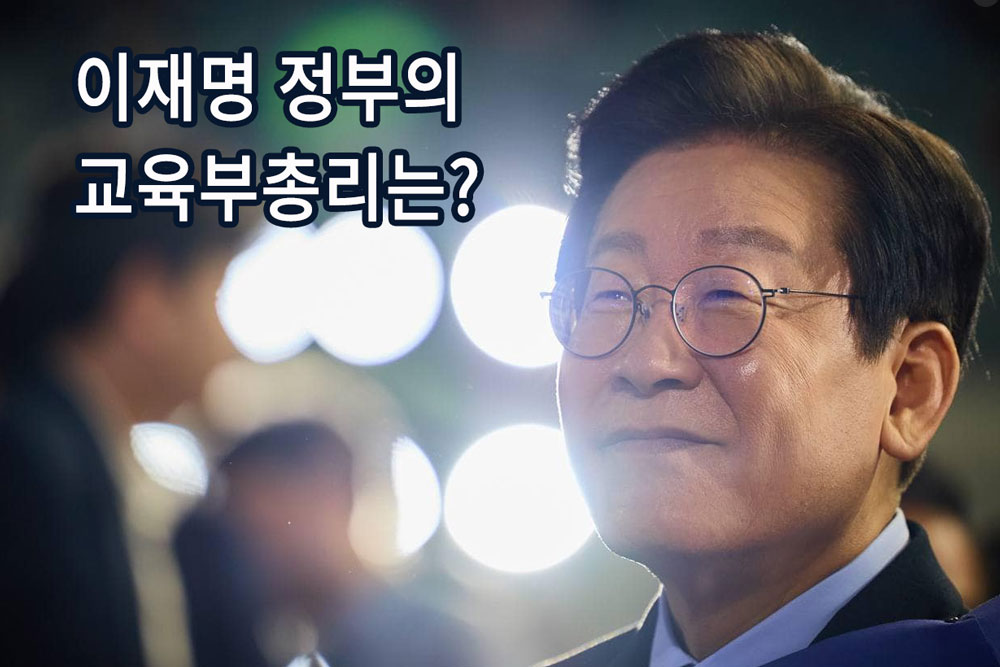
As President-elect Lee Jae-myung prepares to take office and begins the process of selecting cabinet members for the new government, the competition surrounding the position of Deputy Prime Minister of Education is heating up. In particular, there is speculation that individuals with expertise in education policy and a deep understanding of the field will be prioritized over political figures, as the President-elect expressed during the election period that he would avoid relying too heavily on close aides.
Among the prominent figures currently being considered are Lee Nam-ho, former president of the Jeonbuk Research Institute, and Kang Min-jeong, a former member of the National Assembly. Lee Nam-ho, who previously served as the president of Jeonbuk University, is an expert in the field of higher education, having provided systematic diagnoses and alternatives for issues such as the crisis facing local universities due to declining student populations and university restructuring. He is highly regarded for his work at the Jeonbuk Research Institute, where he has addressed sustainable development strategies linking the region, universities, and industry, demonstrating an ability to encompass both education and regional policies. Additionally, it is known that he has been involved in research meetings with experts from various levels of elementary and secondary education for a long time, and his connection with Lee Han-joo, the head of the Democratic Research Institute, is also considered a significant factor.
On the other hand, Kang Min-jeong, a former member of the National Assembly, is a leading figure in public education policy. Coming from a teaching background, she has both engaged in civil society activities and served on the National Assembly's Education Committee, actively advocating for progressive education agendas such as a cautious approach to the introduction of the high school credit system, narrowing educational disparities, and expanding childcare policies. Especially in the current debate over the transition in education policies such as digital textbooks and flexible schools, Kang's advocacy for the restoration of the public nature of education is significant. She is classified as an individual whose views align with the policy direction of the Lee Jae-myung government, which emphasizes the normalization of public education.
Various other individuals are also being mentioned in the discussions, clouding the outline of the appointments. Kim Young-ho, a member of the Democratic Party and chairman of the National Assembly's Education Committee, is considered a heavyweight candidate with a background in legislative adjustments and a comprehensive understanding of education policy. However, the possibility of appointments centered around political figures conflicts with the President-elect's stance, making the actual likelihood of such appointments fluid.
Representative Baek Seung-a, a former elementary school teacher and an expert in the field, represents the voice of the young education sector. Through her activities with the Teachers' Union, she has consistently raised issues related to school democracy, the balance between educational authority and student rights, and has recently emphasized the need for practical intervention from a field perspective on expanding childcare and the necessity of AI digital education environments. She is being recognized as someone who can translate on-the-ground sensibilities into policy.
Lee Han-joo, the head of the Democratic Research Institute, who is evaluated as the key policy brain of President-elect Lee Jae-myung, is also being mentioned as a candidate for Deputy Prime Minister of Education. Having served as the head of the Gyeonggi Research Institute and the policy director of the Central Committee, he has dealt with various policy areas, including education, and has overseen the implementation of the new government's education promises such as digital transformation and the establishment of a lifelong learning system. However, he is also being considered as a candidate for the role of Chief of the Presidential Policy Office, making it a crucial point to observe whether he will be appointed as Deputy Prime Minister of Education.
Within and outside the education sector, it is believed that the appointment of the Deputy Prime Minister of Education this time holds more significance than just filling a position. This is because the criteria for appointments are expected to be based on what educational philosophy the new government will adopt to steer the direction of education reform and whether it will prioritize policy capacity over political considerations. The education agenda of the new government is far from light, with major issues such as the introduction of AI-based digital textbooks, the controversy surrounding flexible schools like Rebox School, the push for normalization of the high school credit system, and the problem of university restructuring due to a sharp decline in the student population. In this situation, the individuals who possess practical policy adjustment abilities and an understanding of the field, as well as who the Lee Jae-myung government will prioritize based on what values, are expected to be the key factors in the appointments.
The Jeonbuk Joint Education Commission stated, "At present, the continuity of policies and their feasibility are more important than political rewards or factional considerations," and expressed that individuals appointed should understand and have the practical drive to address education issues ranging from early childhood education to higher education.
? Brief Summary:
As President-elect Lee Jae-myung prepares to select cabinet members for the new government, there is competition for the position of Deputy Prime Minister of Education. Experts in education policy are likely to be prioritized over political figures, with individuals like Lee Nam-ho and Kang Min-jeong being considered.
?️ Natural Korean Translation:
이재명 당선자가 새 정부를 위한 내각 구성원을 선정하면서, 교육부 차관의 경쟁이 치열해지고 있습니다. 교육 정책 전문가들이 정치인들보다 우선적으로 고려될 것으로 예상되며, 이를 위한 후보로 이남호와 강민정 등이 고려되고 있습니다.
❓ Comprehension Questions:
1. What is the focus of the competition surrounding the position of Deputy Prime Minister of Education?
교육부장관 지위를 둘러싼 경쟁의 중점은 무엇인가요?
2. Who are some of the prominent figures being considered for the position of Deputy Prime Minister of Education?
교육부장관 지위를 고려 중인 주요 인물은 누구인가요?
3. Why is the appointment of the Deputy Prime Minister of Education considered significant this time?
이번 교육부장관의 임명이 중요하다고 여겨지는 이유는 무엇인가요?
? Vocabulary Learning:
1. expertise (전문지식), noun
- specialized knowledge or skill in a particular area
- 특정 분야에서의 전문 지식 또는 기술
- She has extensive expertise in the field of neuroscience.
- 그녀는 신경과학 분야에서 광범위한 전문 지식을 가지고 있습니다.
2. speculation (추측), noun
- the forming of a theory or conjecture without firm evidence
- 단단한 증거 없이 이론이나 추측을 세우는 것
- There is much speculation about the outcome of the upcoming election.
- 다가오는 선거 결과에 대한 많은 추측이 있습니다.
3. prominent (두드러진), adjective
- important; famous
- 중요한; 유명한
- The company is known for its prominent role in environmental conservation.
- 그 회사는 환경 보전에서 두드러진 역할을 하는 것으로 알려져 있습니다.
4. encompass (포함하다), verb
- to include comprehensively
- 포괄적으로 포함하다
- The report encompasses all aspects of the research project.
- 보고서는 연구 프로젝트의 모든 측면을 포함하고 있습니다.
5. normalization (정상화), noun
- the process of making something normal or standard
- 무엇을 정상적이거나 표준적으로 만드는 과정
- The normalization of relations between the two countries has been a long process.
- 두 나라 간의 관계 정상화는 긴 과정을 거쳐왔습니다.

💬 댓글 (0)
댓글을 작성하려면 로그인이 필요합니다.
로그인첫 댓글을 작성해보세요!